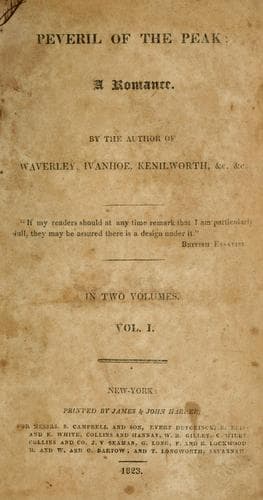
Great Britain -- History -- Charles II, 1660-1685 -- Fiction
“Thou art sharp, Jerningham,” said the Duke--“in one sense I have, and
I may again. So now, that pearl-coloured will do with the ribbon and
George. Get away with thee.--And now that he is gone, Master Christian,
may I once more crave your pleasure?”
“My Lord Duke,” said Christian, “you are a worshipper of difficulties in
state affairs, as in love matters.”
“I trust you have been no eavesdropper, Master Christian,” replied the
Duke; “it scarce argues the respect due to me, or to my roof.”
“I know not what you mean, my lord,” replied Christian.
“Nay, I care not if the whole world heard what I said but now to
Jerningham. But to the matter,” replied the Duke of Buckingham.
“Your Grace is so much occupied with conquests over the fair and over
the witty, that you have perhaps forgotten what a stake you have in the
little Island of Man.”
“Not a whit, Master Christian. I remember well enough that my
roundheaded father-in-law, Fairfax, had the island from the Long
Parliament; and was ass enough to quit hold of it at the Restoration,
when, if he had closed his clutches, and held fast, like a true bird of
prey, as he should have done, he might have kept it for him and his.
It had been a rare thing to have had a little kingdom--made laws of
my own--had my Chamberlain with his white staff--I would have taught
Jerningham, in half a day, to look as wise, walk as stiffly, and speak
as silly, as Harry Bennet.”
“You might have done this, and more, if it had pleased your Grace.”
“Ay, and if it had pleased my Grace, thou, Ned Christian, shouldst have
been the Jack Ketch of my dominions.”
“_I_ your Jack Ketch, my lord?” said Christian, more in a tone of
surprise than of displeasure.
“Why, ay; thou hast been perpetually intriguing against the life of
yonder poor old woman. It were a kingdom to thee to gratify thy spleen
with thy own hands.”
“I only seek justice against the Countess,” said Christian.
“And the end of justice is always a gibbet,” said the Duke.
“Be it so,” answered Christian. “Well, the Countess is in the Plot.”
“The devil confound the Plot, as I believe he first invented it!” said
the Duke of Buckingham; “I have heard of nothing else for months. If one
must go to hell, I would it were by some new road, and in gentlemen’s
company. I should not like to travel with Oates, Bedloe, and the rest of
that famous cloud of witnesses.”
“Your Grace is then resolved to forego all the advantages which may
arise? If the House of Derby fall under forfeiture, the grant to
Fairfax, now worthily represented by your Duchess, revives, and you
become the Lord and Sovereign of Man.”
“In right of a woman,” said the Duke; “but, in troth, my godly dame owes
me some advantage for having lived the first year of our marriage with
her and old Black Tom, her grim, fighting, puritanic father. A man might
as well have married the Devil’s daughter, and set up housekeeping with
his father-in-law.” [*]
Public-domain text, read in full here on John Shaqi.
Reviews
Reviews
No reviews yet
Be the first to share your thoughts on this work.
Elsewhere in the archive
Join the Discussion
Join the discussion
Sign in to leave a comment or review.
Sign InorCreate an account