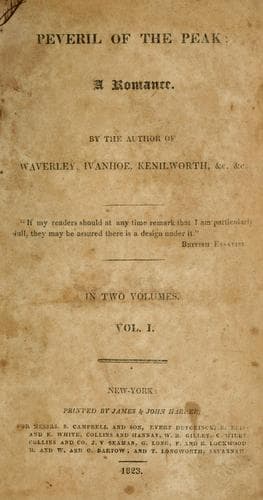
Great Britain -- History -- Charles II, 1660-1685 -- Fiction
But Christian had too much cunning to expatiate on this theme,
however soothing. He stopped short exactly at the point where, as an
affectionate relative, he might be supposed to have said enough. “The
lady,” he said, “with whom he had placed Alice, was delighted with her
aspect and manners, and undertook to be responsible for her health and
happiness. He had not, he said, deserved so little confidence at the
hand of his brother, Bridgenorth, as that the Major should, contrary
to his purpose, and to the plan which they had adjusted together, have
hurried up from the country, as if his own presence were necessary for
Alice’s protection.”
“Brother Christian,” said Bridgenorth in reply, “I must see my child--I
must see this person with whom she is entrusted.”
“To what purpose?” answered Christian. “Have you not often confessed
that the over excess of the carnal affection which you have entertained
for your daughter, hath been a snare to you?--Have you not, more than
once, been on the point of resigning those great designs which should
place righteousness as a counsellor beside the throne, because you
desired to gratify your daughter’s girlish passion for this descendant
of your old persecutor--this Julian Peveril?”
“I own it,” said Bridgenorth; “and worlds would I have given, and would
yet give, to clasp that youth to my bosom, and call him my son. The
spirit of his mother looks from his eye, and his stately step is as that
of his father, when he daily spoke comfort to me in my distress, and
said, ‘The child liveth.’”
“But the youth walks,” said Christian, “after his own lights, and
mistakes the meteor of the marsh for the Polar star. Ralph Bridgenorth,
I will speak to thee in friendly sincerity. Thou must not think to
serve both the good cause and Baal. Obey, if thou wilt, thine own carnal
affections, summon this Julian Peveril to thy house, and let him wed thy
daughter--But mark the reception she will meet with from the proud old
knight, whose spirit is now, even now, as little broken with his chains,
as after the sword of the Saints had prevailed at Worcester. Thou wilt
see thy daughter spurned from his feet like an outcast.”
“Christian,” said Bridgenorth, interrupting him, “thou dost urge me
hard; but thou dost it in love, my brother, and I forgive thee--Alice
shall never be spurned.--But this friend of thine--this lady--thou
art my child’s uncle; and after me, thou art next to her in love and
affection--Still, thou art not her father--hast not her father’s
fears. Art thou sure of the character of this woman to whom my child is
entrusted?”
“Am I sure of my own?--Am I sure that my name is Christian--yours
Bridgenorth?--Is it a thing I am likely to be insecure in?--Have I not
dwelt for many years in this city?--Do I not know this Court?--And am I
likely to be imposed upon? For I will not think you can fear my imposing
upon you.”
Public-domain text, read in full here on John Shaqi.
Reviews
Reviews
No reviews yet
Be the first to share your thoughts on this work.
Elsewhere in the archive
Join the Discussion
Join the discussion
Sign in to leave a comment or review.
Sign InorCreate an account