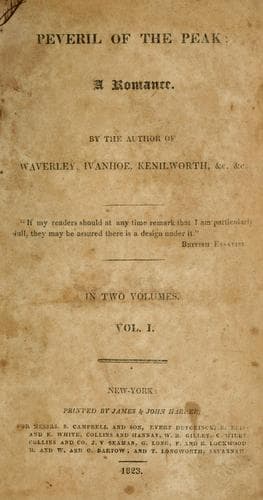
Great Britain -- History -- Charles II, 1660-1685 -- Fiction
After cautiously sounding Christian, and finding that the near prospect
of interest to himself effectually prevented his starting at this
iniquitous scheme, Chiffinch detailed it to him fully, carefully keeping
the final termination out of sight, and talking of the favour to be
acquired by the fair Alice as no passing caprice, but the commencement
of a reign as long and absolute as that of the Duchess of Portsmouth,
of whose avarice and domineering temper Charles was now understood to
be much tired, though the force of habit rendered him unequal to free
himself of her yoke.
Thus chalked out, the scene prepared was no longer the intrigue of a
Court pander, and a villainous resolution for the ruin of an innocent
girl, but became a state intrigue, for the removal of an obnoxious
favourite, and the subsequent change of the King’s sentiments upon
various material points, in which he was at present influenced by the
Duchess of Portsmouth. In this light it was exhibited to the Duke of
Buckingham, who, either to sustain his character for daring gallantry,
or in order to gratify some capricious fancy, had at one time made love
to the reigning favourite, and experienced a repulse which he had never
forgiven.
But one scheme was too little to occupy the active and enterprising
spirit of the Duke. An appendix of the Popish Plot was easily so
contrived as to involve the Countess of Derby, who, from character and
religion, was precisely the person whom the credulous part of the public
were inclined to suppose the likely accomplice of such a conspiracy.
Christian and Bridgenorth undertook the perilous commission of attacking
her even in her own little kingdom of Man, and had commissions for this
purpose, which were only to be produced in case of their scheme taking
effect.
It miscarried, as the reader is aware, from the Countess’s alert
preparations for defence; and neither Christian nor Bridgenorth held
it sound policy to practise openly, even under parliamentary authority,
against a lady so little liable to hesitate upon the measures most
likely to secure her feudal sovereignty; wisely considering that
even the omnipotence, as it has been somewhat too largely styled, of
Parliament, might fail to relieve them from the personal consequences of
a failure.
Public-domain text, read in full here on John Shaqi.
Reviews
Reviews
No reviews yet
Be the first to share your thoughts on this work.
Elsewhere in the archive
Join the Discussion
Join the discussion
Sign in to leave a comment or review.
Sign InorCreate an account