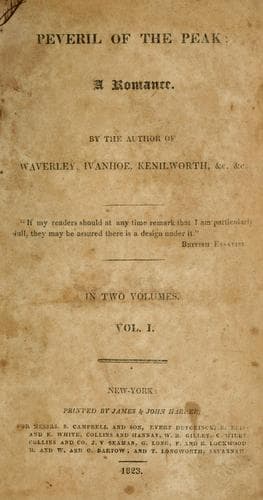
Great Britain -- History -- Charles II, 1660-1685 -- Fiction
While he hesitated to follow his dumb guide any nearer, and felt the
embarrassment of being unable to communicate to her his repugnance to
further intrusion, a person in the royal retinue touched a light and
lively air on the flageolet, at a signal from the King, who desired
to have some tune repeated which had struck him in the theatre on the
preceding evening. While the good-natured monarch marked time with his
foot, and with the motion of his hand, Fenella continued to approach
him, and threw into her manner the appearance of one who was attracted,
as it were in spite of herself, by the sounds of the instrument.
Anxious to know how this was to end, and astonished to see the dumb girl
imitate so accurately the manner of one who actually heard the musical
notes, Peveril also drew near, though at somewhat greater distance.
The King looked good-humouredly at both, as if he admitted their musical
enthusiasm as an excuse for their intrusion; but his eyes became riveted
on Fenella, whose face and appearance, although rather singular than
beautiful, had something in them wild, fantastic, and, as being so, even
captivating, to an eye which had been gratified perhaps to satiety with
the ordinary forms of female beauty. She did not appear to notice
how closely she was observed; but, as if acting under an irresistible
impulse, derived from the sounds to which she seemed to listen, she
undid the bodkin round which her long tresses were winded, and flinging
them suddenly over her slender person, as if using them as a natural
veil, she began to dance, with infinite grace and agility, to the tune
which the flageolet played.
Peveril lost almost his sense of the King’s presence, when he observed
with what wonderful grace and agility Fenella kept time to notes, which
could only be known to her by the motions of the musician’s fingers.
He had heard, indeed, among other prodigies, of a person in Fenella’s
unhappy situation acquiring, by some unaccountable and mysterious
tact, the power of acting as an instrumental musician, nay, becoming so
accurate a performer as to be capable of leading a musical band; and he
also heard of deaf and dumb persons dancing with sufficient accuracy, by
observing the motions of their partner. But Fenella’s performance seemed
more wonderful than either, since the musician was guided by his written
notes, and the dancer by the motions of the others; whereas Fenella had
no intimation, save what she seemed to gather, with infinite accuracy,
by observing the motion of the artist’s fingers on his small instrument.
Public-domain text, read in full here on John Shaqi.
Reviews
Reviews
No reviews yet
Be the first to share your thoughts on this work.
Elsewhere in the archive
Join the Discussion
Join the discussion
Sign in to leave a comment or review.
Sign InorCreate an account