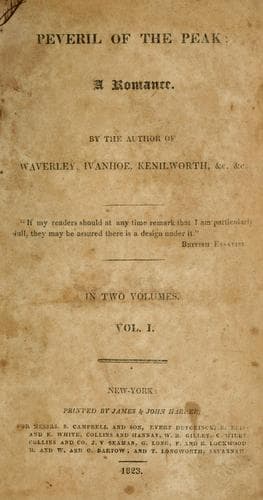
Great Britain -- History -- Charles II, 1660-1685 -- Fiction
That the necessary introduction might take place, the confederates
judged fit she should be put under the charge of an experienced
lady, whom some called Mistress Chiffinch, and others Chiffinch’s
mistress--one of those obliging creatures who are willing to discharge
all the duties of a wife, without the inconvenient and indissoluble
ceremony.
It was one, and not perhaps the least prejudicial consequence of the
license of that ill-governed time, that the bounds betwixt virtue and
vice were so far smoothed down and levelled, that the frail wife, or the
tender friend who was no wife, did not necessarily lose their place in
society; but, on the contrary, if they moved in the higher circles, were
permitted and encouraged to mingle with women whose rank was certain,
and whose reputation was untainted.
A regular _liaison_, like that of Chiffinch and his fair one, inferred
little scandal; and such was his influence, as prime minister of his
master’s pleasures, that, as Charles himself expressed it, the lady whom
we introduced to our readers in the last chapter, had obtained a
brevet commission to rank as a married woman. And to do the gentle dame
justice, no wife could have been more attentive to forward his plans, or
more liberal in disposing of his income.
She inhabited a set of apartments called Chiffinch’s--the scene of many
an intrigue, both of love and politics; and where Charles often held
his private parties for the evening, when, as frequently happened, the
ill-humour of the Duchess of Portsmouth, his reigning Sultana, prevented
his supping with her. The hold which such an arrangement gave a man
like Chiffinch, used as he well knew how to use it, made him of too
much consequence to be slighted even by the first persons in the state,
unless they stood aloof from all manner of politics and Court intrigue.
In the charge of Mistress Chiffinch, and of him whose name she bore,
Edward Christian placed the daughter of his sister, and of his confiding
friend, calmly contemplating her ruin as an event certain to follow; and
hoping to ground upon it his own chance of a more assured fortune, than
a life spent in intrigue had hitherto been able to procure for him.
Public-domain text, read in full here on John Shaqi.
Reviews
Reviews
No reviews yet
Be the first to share your thoughts on this work.
Elsewhere in the archive
Join the Discussion
Join the discussion
Sign in to leave a comment or review.
Sign InorCreate an account