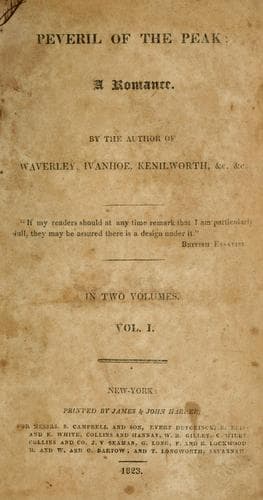
Great Britain -- History -- Charles II, 1660-1685 -- Fiction
Charles paused, as the Duke spoke, beside a window which looked full on
Whitehall, and his eye was involuntarily attracted by the fatal window
of the Banqueting House out of which his unhappy father was conducted to
execution. Charles was naturally, or, more purposely, constitutionally
brave; but a life of pleasure, together with the habit of governing his
course rather by what was expedient than by what was right, rendered him
unapt to dare the same scene of danger or of martyrdom, which had closed
his father’s life and reign; and the thought came over his half-formed
resolution, like the rain upon a kindling beacon. In another man, his
perplexity would have seemed almost ludicrous; but Charles would not
lose, even under these circumstances, the dignity and grace, which were
as natural to him as his indifference and good humour. “Our Council must
decide in this matter,” he said, looking to the Duke; “and be assured,
young man,” he added, addressing Julian, “your father shall not want an
intercessor in his King, so far as the laws will permit my interference
in his behalf.”
Julian was about to retire, when Fenella, with a marked look, put
into his hand a slip of paper, on which she had hastily written, “The
packet--give him the packet.”
After a moment’s hesitation, during which he reflected that Fenella was
the organ of the Countess’s pleasure, Julian resolved to obey. “Permit
me, then, Sire,” he said, “to place in your royal hands this packet,
entrusted to me by the Countess of Derby. The letters have already been
once taken from me; and I have little hope that I can now deliver them
as they are addressed. I place them, therefore, in your royal hands,
certain that they will evince the innocence of the writer.”
The King shook his head as he took the packet reluctantly. “It is no
safe office you have undertaken, young man. A messenger has sometimes
his throat cut for the sake of his despatches--But give them to me; and,
Chiffinch, give me wax and a taper.” He employed himself in folding the
Countess’s packet in another envelope. “Buckingham,” he said, “you are
evidence that I do not read them till the Council shall see them.”
Buckingham approached, and offered his services in folding the parcel,
but Charles rejected his assistance; and having finished his task, he
sealed the packet with his own signet-ring. The Duke bit his lip and
retired.
“And now, young man,” said the King, “your errand is sped, so far as it
can at present be forwarded.”
Public-domain text, read in full here on John Shaqi.
Reviews
Reviews
No reviews yet
Be the first to share your thoughts on this work.
Elsewhere in the archive
Join the Discussion
Join the discussion
Sign in to leave a comment or review.
Sign InorCreate an account