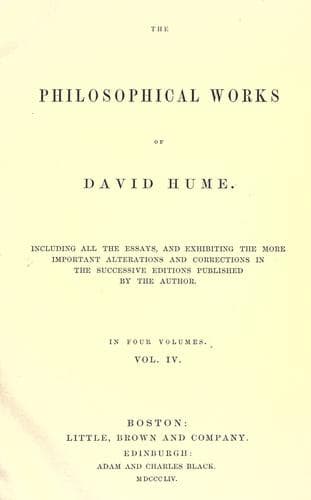
Philosophical Works, v. 1 (of 4): Including All the Essays, and Exhibiting the More Important Alterations and Corrections in the Successive Editions Published by the AuthorHume, David
PhilosophyPhilosophy
Philosophical Works, v. 1 (of 4): Including All the Essays, and Exhibiting the More Important Alterations and Corrections in the Successive Editions Published by the Author
Hume, David
Knowledge, Theory of; Philosophy, English -- 18th century
I first ask mathematicians what they mean when they say one line or
surface is _equal_ to, or _greater_, or _less_ than another? Let any
of them give an answer, to whatever sect he belongs, and whether he
maintains the composition of extension by indivisible points, or by
quantities divisible _in infinitum_. This question will embarrass both
of them.
There are few or no mathematicians who defend the hypothesis of
indivisible points, and yet these have the readiest and justest answer
to the present question. They need only reply, that lines or surfaces
are equal, when the numbers of points in each are equal; and that as
the proportion of the numbers varies, the proportion of the lines and
surfaces is also varied. But though this answer be _just_ as well as
obvious, yet I may affirm, that this standard of equality is entirely
_useless_, and that it never is from such a comparison we determine
objects to be equal or unequal with respect to each other. For as the
points which enter into the composition of any line or surface, whether
perceived by the sight or touch, are so minute and so confounded with
each other that 'tis utterly impossible for the mind to compute their
number, such a computation will never afford us a standard, by which we
may judge of proportions. No one will ever be able to determine by an
exact enumeration, that an inch has fewer points than a foot, or a foot
fewer than an ell, or any greater measure; for which reason, we seldom
or never consider this as the standard of equality or inequality.
As to those who imagine that extension is divisible _in infinitum_,
'tis impossible they can make use of this answer, or fix the equality
of any line or surface by a numeration of its component parts. For
since, according to their hypothesis, the least as well as greatest
figures contain an infinite number of parts, and since infinite
numbers, properly speaking, can neither be equal _nor_ unequal with
respect to each other, the equality or inequality of any portions
of space can never depend on any proportion in the number of their
parts. 'Tis true, it may be said, that the inequality of an ell and a
yard consists in the different numbers of the feet of which they are
composed, and that of a foot and a yard in the number of inches. But
as that quantity we call an inch in the one is supposed equal to what
we call an inch in the other, and as 'tis impossible for the mind to
find this equality by proceeding _in infinitum_ with these references
to inferior quantities, 'tis evident that at last we must fix some
standard of equality different from an enumeration of the parts.
Public-domain text, read in full here on John Shaqi.
Philosophical Works, v. 1 (of 4): Including All the Essays, and Exhibiting the More Important Alterations and Corrections in the Successive Editions Published by the Author — John Shaqi
Reviews
Reviews
No reviews yet
Be the first to share your thoughts on this work.
Elsewhere in the archive
Join the Discussion
Join the discussion
Sign in to leave a comment or review.
Sign InorCreate an account