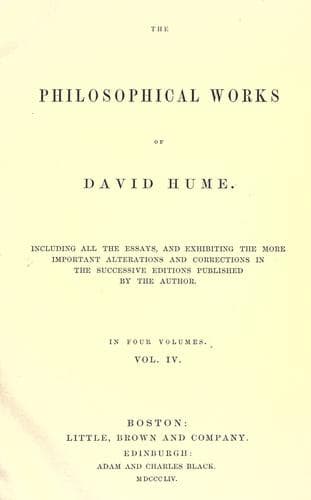
Philosophical Works, v. 1 (of 4): Including All the Essays, and Exhibiting the More Important Alterations and Corrections in the Successive Editions Published by the AuthorHume, David
PhilosophyPhilosophy
Philosophical Works, v. 1 (of 4): Including All the Essays, and Exhibiting the More Important Alterations and Corrections in the Successive Editions Published by the Author
Hume, David
Knowledge, Theory of; Philosophy, English -- 18th century
'Tis true, mathematicians pretend they give an exact definition of
a right line when they say, _it is the shortest way betwixt two
points_. But in the first place I observe, that this is more properly
the discovery of one of the properties of a right line, than a just
definition of it. For I ask any one, if, upon mention of a right line,
he thinks not immediately on such a particular appearance, and if 'tis
not by accident only that he considers this property? A right line can
be comprehended alone; but this definition is unintelligible without a
comparison with other lines, which we conceive to be more extended. In
common life 'tis established as a maxim, that the straightest way is
always the shortest; which would be as absurd as to say, the shortest
way is always the shortest, if our idea of a right line was not
different from that of the shortest way betwixt two points.
Secondly, I repeat, what I have already established, that we have no
precise idea of equality and inequality, shorter and longer, more than
of a right line or a curve; and consequently that the one can never
afford us a perfect standard for the other. An exact idea can never be
built on such as are loose and undeterminate.
The idea of a _plain surface_ is as little susceptible of a precise
standard as that of a right line; nor have we any other means of
distinguishing such a surface, than its general appearance. 'Tis in
vain that mathematicians represent a plain surface as produced by the
flowing of a right line. 'Twill immediately be objected, that our idea
of a surface is as independent of this method of forming a surface, as
our idea of an ellipse is of that of a cone; that the idea of a right
line is no more precise than that of a plain surface; that a right line
may flow irregularly, and by that means form a figure quite different
from a plane; and that therefore we must suppose it to flow along two
right lines, parallel to each other, and on the same plane; which is a
description that explains a thing by itself, and returns in a circle.
Public-domain text, read in full here on John Shaqi.
Reviews
Reviews
No reviews yet
Be the first to share your thoughts on this work.
Elsewhere in the archive
Join the Discussion
Join the discussion
Sign in to leave a comment or review.
Sign InorCreate an account