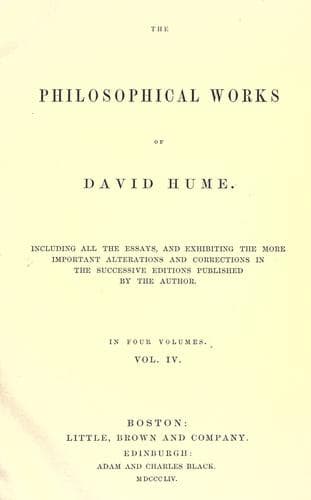
Philosophical Works, v. 1 (of 4): Including All the Essays, and Exhibiting the More Important Alterations and Corrections in the Successive Editions Published by the AuthorHume, David
PhilosophyPhilosophy
Philosophical Works, v. 1 (of 4): Including All the Essays, and Exhibiting the More Important Alterations and Corrections in the Successive Editions Published by the Author
Hume, David
Knowledge, Theory of; Philosophy, English -- 18th century
I answer this objection, by pleading guilty, and by confessing that
my intention never was to penetrate into the nature of bodies, or
explain the secret causes of their operations. For, besides that this
belongs not to my present purpose, I am afraid, that such an enterprise
is beyond the reach of human understanding, and that we can never
pretend to know body otherwise than by those external properties,
which discover themselves to the senses. As to those who attempt any
thing farther, I cannot approve of their ambition, till I see, in
some one instance at least, that they have met with success. But at
present I content myself with knowing perfectly the manner in which
objects affect my senses, and their connexions with each other, as far
as experience informs me of them. This suffices for the conduct of
life; and this also suffices for my philosophy, which pretends only to
explain the nature and causes of our perceptions, or impressions and
ideas.[7]
I shall conclude this subject of extension with a paradox, which will
easily be explained from the foregoing reasoning. This paradox is, that
if you are pleased to give to the invisible and intangible distance,
or in other words, to the capacity of becoming a visible and tangible
distance, the name of a vacuum, extension and matter are the same,
and yet there is a vacuum. If you will not give it that name, motion
is possible in a plenum, without any impulse _in infinitum_, without
returning in a circle, and without penetration. But however we may
express ourselves, we must always confess, that we have no idea of any
real extension without filling it with sensible objects, and conceiving
its parts as visible or tangible.
As to the doctrine, that time is nothing but the manner in which some
real objects exist; we may observe, that 'tis liable to the same
objections as the similar doctrine with regard to extension. If it
be a sufficient proof, that we have the idea of a vacuum, because we
dispute and reason concerning it; we must for the same reason have
the idea of time without any changeable existence; since there is no
subject of dispute more frequent and common. But that we really have
no such idea, is certain. For whence should it be derived? Does it
arise from an impression of sensation or of reflection? Point it out
distinctly to us, that we may know its nature and qualities. But if
you cannot point out _any such impression_, you may be certain you are
mistaken, when you imagine you have _any such idea_.
Public-domain text, read in full here on John Shaqi.
Reviews
Reviews
No reviews yet
Be the first to share your thoughts on this work.
Elsewhere in the archive
Join the Discussion
Join the discussion
Sign in to leave a comment or review.
Sign InorCreate an account