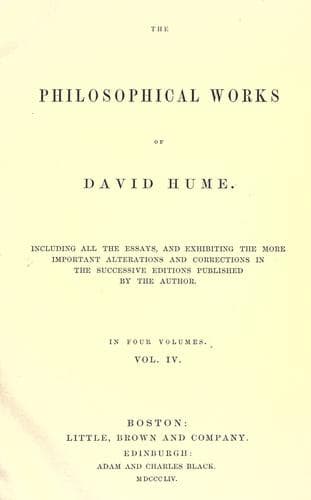
Philosophical Works, v. 1 (of 4): Including All the Essays, and Exhibiting the More Important Alterations and Corrections in the Successive Editions Published by the AuthorHume, David
PhilosophyPhilosophy
Philosophical Works, v. 1 (of 4): Including All the Essays, and Exhibiting the More Important Alterations and Corrections in the Successive Editions Published by the Author
Hume, David
Knowledge, Theory of; Philosophy, English -- 18th century
Our ideas are copied from our impressions, and represent them in all
their parts. When you would any way vary the idea of a particular
object, you can only increase or diminish its force and vivacity. If
you make any other change on it, it represents a different object or
impression. The case is the same as in colours. A particular shade of
any colour may acquire a new degree of liveliness or brightness without
any other variation. But when you produce any other variation, 'tis no
longer the same shade or colour; so that as belief does nothing but
vary the manner in which we conceive any object, it can only bestow on
our ideas an additional force and vivacity. An opinion therefore or
belief may be most accurately defined, _a lively idea related to or
associated with a present impression_.[6]
Here are the heads of those arguments, which lead us to this
conclusion. When we infer the existence of an object from that of
others, some object must always be present either to the memory or
senses, in order to be the foundation of our reasoning; since the mind
cannot run up with its inferences _in infinitum_. Reason can never
satisfy us that the existence of any one object does ever imply that of
another; so that when we pass from the impression of one to the idea or
belief of another, we are not determined by reason, but by custom, or
a principle of association. But belief is somewhat more than a simple
idea. 'Tis a particular manner of forming an idea: and as the same idea
can only be varied by a variation of its degrees of force and vivacity;
it follows upon the whole, that belief is a lively idea produced
by a relation to a present impression, according to the foregoing
definition.
Public-domain text, read in full here on John Shaqi.
Reviews
Reviews
No reviews yet
Be the first to share your thoughts on this work.
Elsewhere in the archive
Join the Discussion
Join the discussion
Sign in to leave a comment or review.
Sign InorCreate an account