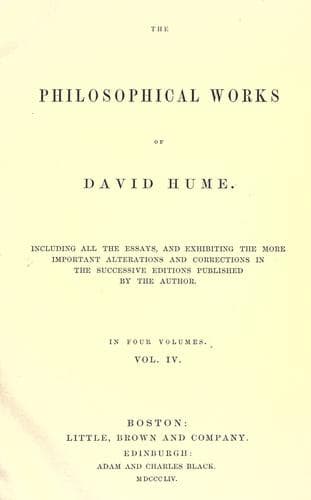
Philosophical Works, v. 1 (of 4): Including All the Essays, and Exhibiting the More Important Alterations and Corrections in the Successive Editions Published by the AuthorHume, David
PhilosophyPhilosophy
Philosophical Works, v. 1 (of 4): Including All the Essays, and Exhibiting the More Important Alterations and Corrections in the Successive Editions Published by the Author
Hume, David
Knowledge, Theory of; Philosophy, English -- 18th century
'Tis this latter principle which peoples the world, and brings us
acquainted with such existences as, by their removal in time and
place, lie beyond the reach of the senses and memory. By means of it
I paint the universe in my imagination, and fix my attention on any
part of it I please. I form an idea of Rome, which I neither see nor
remember, but which is connected with such impressions as I remember
to have received from the conversation and books of travellers and
historians. This idea of Rome I place in a certain situation on the
idea of an object which I call the globe. I join to it the conception
of a particular government, and religion and manners. I look backward
and consider its first foundation, its several revolutions, successes
and misfortunes. All this, and every thing else which I believe, are
nothing but ideas, though, by their force and settled order, arising
from custom and the relation of cause and effect, they distinguish
themselves from the other ideas, which are merely the offspring of the
imagination.
As to the influence of contiguity and resemblance, we may observe, that
if the contiguous and resembling object be comprehended in this system
of realities, there is no doubt but these two relations will assist
that of cause and effect, and infix the related idea with more force
in the imagination. This I shall enlarge upon presently. Meanwhile I
shall carry my observation a step farther, and assert, that even where
the related object is but feigned, the relation will serve to enliven
the idea, and increase its influence. A poet, no doubt, will be the
better able to form a strong description of the Elysian fields, that he
prompts his imagination by the view of a beautiful meadow or garden;
as at another time he may, by his fancy, place himself in the midst of
these fabulous regions, that by the feigned contiguity he may enliven
his imagination.
Public-domain text, read in full here on John Shaqi.
Reviews
Reviews
No reviews yet
Be the first to share your thoughts on this work.
Elsewhere in the archive
Join the Discussion
Join the discussion
Sign in to leave a comment or review.
Sign InorCreate an account