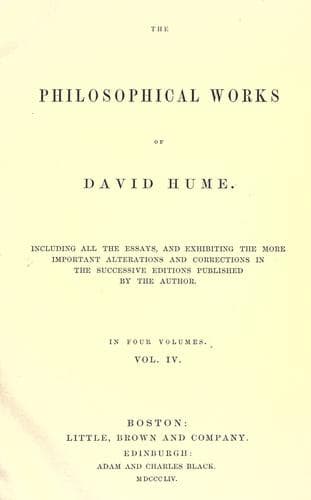
Philosophical Works, v. 1 (of 4): Including All the Essays, and Exhibiting the More Important Alterations and Corrections in the Successive Editions Published by the AuthorHume, David
PhilosophyPhilosophy
Philosophical Works, v. 1 (of 4): Including All the Essays, and Exhibiting the More Important Alterations and Corrections in the Successive Editions Published by the Author
Hume, David
Knowledge, Theory of; Philosophy, English -- 18th century
To begin with contiguity; it has been remarked among the Mahometans
as well as Christians, that those _pilgrims_, who have seen Mecca or
the Holy Land are ever after more faithful and zealous believers, than
those who have not had that advantage. A man, whose memory presents
him with a lively image of the Red Sea, and the Desert, and Jerusalem,
and Galilee, can never doubt of any miraculous events, which are
related either by Moses or the Evangelists. The lively idea of the
places passes by an easy transition to the facts, which are supposed
to have been related to them by contiguity, and increases the belief
by increasing the vivacity of the conception. The remembrance of
these fields and rivers has the same influence on the vulgar as a new
argument, and from the same causes.
We may form a like observation concerning _resemblance_. We have
remarked, that the conclusion which we draw from a present object to
its absent cause or effect, is never founded on any qualities which
we observe in that object, considered in itself; or, in other words,
that 'tis impossible to determine otherwise than by experience, what
will result from any phenomenon, or what has preceded it. But though
this be so evident in itself, that it seemed not to require any proof,
yet some philosophers have imagined that there is an apparent cause
for the communication of motion, and that a reasonable man might
immediately infer the motion of one body from the impulse of another,
without having recourse to any past observation. That this opinion is
false will admit of an easy proof. For if such an inference may be
drawn merely from the ideas of body, of motion, and of impulse, it must
amount to a demonstration, and must imply the absolute impossibility of
any contrary supposition. Every effect, then, beside the communication
of motion, implies a formal contradiction; and 'tis impossible not only
that it can exist, but also that it can be conceived. But we may soon
satisfy ourselves of the contrary, by forming a clear and consistent
idea of one body's moving upon another, and of its rest immediately
upon the contact; or of its returning back in the same line in which
it came; or of its annihilation, or circular or elliptical motion:
and in short, of an infinite number of other changes, which they may
suppose it to undergo. These suppositions are all consistent and
natural; and the reason why we imagine the communication of motion
to be more consistent and natural, not only than those suppositions,
but also than any other natural effect, is founded on the relation of
_resemblance_ betwixt the cause and effect, which is here united to
experience, and binds the objects in the closest and most intimate
manner to each other, so as to make us imagine them to be absolutely
inseparable. Resemblance, then, has the same or a parallel influence
with experience; and as the only immediate effect of experience is to
associate our ideas together, it follows that all belief arises from
Public-domain text, read in full here on John Shaqi.
Reviews
Reviews
No reviews yet
Be the first to share your thoughts on this work.
Elsewhere in the archive
Join the Discussion
Join the discussion
Sign in to leave a comment or review.
Sign InorCreate an account