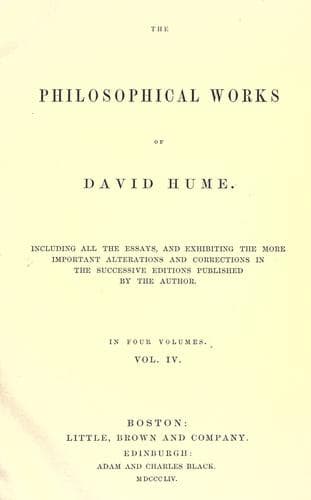
Philosophical Works, v. 1 (of 4): Including All the Essays, and Exhibiting the More Important Alterations and Corrections in the Successive Editions Published by the AuthorHume, David
PhilosophyPhilosophy
Philosophical Works, v. 1 (of 4): Including All the Essays, and Exhibiting the More Important Alterations and Corrections in the Successive Editions Published by the Author
Hume, David
Knowledge, Theory of; Philosophy, English -- 18th century
This mixture of truth and falsehood in the fables of tragic poets not
only serves our present purpose, by showing that the imagination can
be satisfied without any absolute belief or assurance; but may in
another view be regarded as a very strong confirmation of this system.
'Tis evident, that poets make use of this artifice of borrowing the
names of their persons, and the chief events of their poems, from
history, in order to procure a more easy reception for the whole, and
cause it to make a deeper impression on the fancy and affections. The
several incidents of the piece acquire a kind of relation by being
united into one poem or representation; and if any of these incidents
be an object of belief, it bestows a force and vivacity on the others,
which are related to it. The vividness of the first conception diffuses
itself along the relations, and is conveyed, as by so many pipes or
canals, to every idea that has any communication with the primary one.
This indeed can never amount to a perfect assurance; and that because
the union among the ideas is in a manner accidental: but still it
approaches so near in its influence, as may convince us that they are
derived from the same origin. Belief must please the imagination by
means of the force and vivacity which attends it; since every idea,
which has force and vivacity, is found to be agreeable to that faculty.
To confirm this we may observe, that the assistance is mutual betwixt
the judgment and fancy, as well as betwixt the judgment and passion;
and that belief not only gives vigour to the imagination, but that a
vigorous and strong imagination is of all talents the most proper to
procure belief and authority. 'Tis difficult for us to withhold our
assent from what is painted out to us in all the colours of eloquence;
and the vivacity produced by the fancy is in many cases greater than
that which arises from custom and experience. We are hurried away by
the lively imagination of our author or companion; and even he himself
is often a victim to his own fire and genius.
Public-domain text, read in full here on John Shaqi.
Reviews
Reviews
No reviews yet
Be the first to share your thoughts on this work.
Elsewhere in the archive
Join the Discussion
Join the discussion
Sign in to leave a comment or review.
Sign InorCreate an account