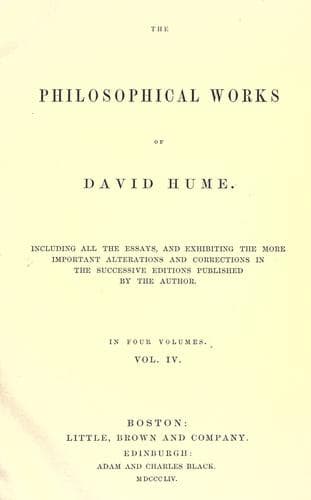
Philosophical Works, v. 1 (of 4): Including All the Essays, and Exhibiting the More Important Alterations and Corrections in the Successive Editions Published by the AuthorHume, David
PhilosophyPhilosophy
Philosophical Works, v. 1 (of 4): Including All the Essays, and Exhibiting the More Important Alterations and Corrections in the Successive Editions Published by the Author
Hume, David
Knowledge, Theory of; Philosophy, English -- 18th century
Those philosophers who have divided human reason into _knowledge and
probability_, and have defined the first to be _that evidence which
arises from the comparison of ideas_, are obliged to comprehend all our
arguments from causes or effects under the general term of probability.
But though every one be free to use his terms in what sense he pleases;
and accordingly, in the precedent part of this discourse, I have
followed this method of expression; 'tis however certain, that in
common discourse we readily affirm, that many arguments from causation
exceed probability, and may be received as a superior kind of evidence.
One would appear ridiculous who would say, that 'tis only probable the
sun will rise to-morrow, or that all men must die; though 'tis plain we
have no further assurance of these facts than what experience affords
us. For this reason t'would perhaps be more convenient, in order at
once to preserve the common signification of words, and mark the
several degrees of evidence, to distinguish human reason into three
kinds, viz. _that from knowledge, from proofs, and from probabilities_.
By knowledge, I mean the assurance arising from the comparison of
ideas. By proofs, those arguments which are derived from the relation
of cause and effect, and which are entirely free from doubt and
uncertainty. By probability, that evidence which is still attended with
uncertainty. 'Tis this last species of reasoning I proceed to examine.
Probability or reasoning from conjecture may be divided into two kinds,
viz. that which is founded on _chance_, and that which arises from
_causes_. We shall consider each of these in order.
The idea of cause and effect is derived from experience, which,
presenting us with certain objects constantly conjoined with each
other, produces such a habit of surveying them in that relation, that
we cannot, without a sensible violence, survey them in any other. On
the other hand, as chance is nothing real in itself, and, properly
speaking, is merely the negation of a cause, its influence on the mind
is contrary to that of causation; and 'tis essential to it to leave the
imagination perfectly indifferent, either to consider the existence or
non-existence of that object which is regarded as contingent. A cause
traces the way to our thought, and in a manner forces us to survey such
certain objects in such certain relations. Chance can only destroy
this determination of the thought, and leave the mind in its native
situation of indifference; in which, upon the absence of a cause, 'tis
instantly reinstated.
Public-domain text, read in full here on John Shaqi.
Reviews
Reviews
No reviews yet
Be the first to share your thoughts on this work.
Elsewhere in the archive
Join the Discussion
Join the discussion
Sign in to leave a comment or review.
Sign InorCreate an account