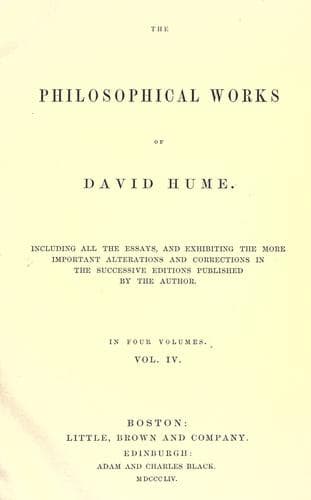
Philosophical Works, v. 1 (of 4): Including All the Essays, and Exhibiting the More Important Alterations and Corrections in the Successive Editions Published by the AuthorHume, David
PhilosophyPhilosophy
Philosophical Works, v. 1 (of 4): Including All the Essays, and Exhibiting the More Important Alterations and Corrections in the Successive Editions Published by the Author
Hume, David
Knowledge, Theory of; Philosophy, English -- 18th century
Proceeding, then, in that reasoning, wherein we have advanced three
steps; _that_ chance is merely the negation of a cause, and produces a
total indifference in the mind; _that_ one negation of a cause and one
total indifference can never be superior or inferior to another; and
_that_ there must always be a mixture of causes among the chances, in
order to be the foundation of any reasoning. We are next to consider
what effect a superior combination of chances can have upon the mind,
and after what manner it influences our judgment and opinion. Here
we may repeat all the same arguments we employed in examining that
belief which arises from causes; and may prove, after the same manner,
that a superior number of chances produces our assent neither by
_demonstration_ nor _probability_. 'Tis indeed evident, that we can
never, by the comparison of mere ideas, make any discovery which can
be of consequence in this affair, and that 'tis impossible to prove
with certainty that any event must fall on that side were there is a
superior number of chances. To suppose in this case any certainty, were
to overthrow what we have established concerning the opposition of
chances, and their perfect equality and indifference.
Should it be said, that though in an opposition of chances, 'tis
impossible to determine with _certainty_ on which side the event will
fall, yet we can pronounce with certainty, that 'tis more likely and
probable 'twill be on that side where there is a superior number of
chances, than where there is an inferior: should this be said, I
would ask, what is here meant by _likelihood and probability_? The
likelihood and probability of chances is a superior number of equal
chances; and consequently, when we say 'tis likely the event will fall
on the side which is superior, rather than on the inferior, we do no
more than affirm, that where there is a superior number of chances
there is actually a superior, and where there is an inferior there is
an inferior, which are identical propositions, and of no consequence.
The question is, by what means a superior number of equal chances
operates upon the mind, and produces belief or assent, since it appears
that 'tis neither by arguments derived from demonstration, nor from
probability.
Public-domain text, read in full here on John Shaqi.
Reviews
Reviews
No reviews yet
Be the first to share your thoughts on this work.
Elsewhere in the archive
Join the Discussion
Join the discussion
Sign in to leave a comment or review.
Sign InorCreate an account