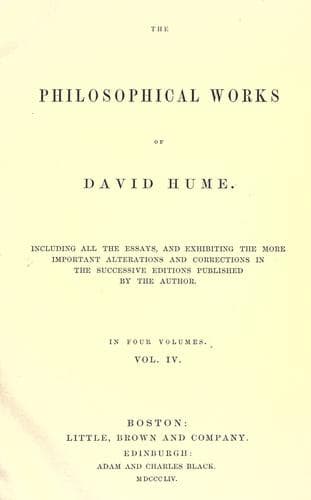
Philosophical Works, v. 1 (of 4): Including All the Essays, and Exhibiting the More Important Alterations and Corrections in the Successive Editions Published by the AuthorHume, David
PhilosophyPhilosophy
Philosophical Works, v. 1 (of 4): Including All the Essays, and Exhibiting the More Important Alterations and Corrections in the Successive Editions Published by the Author
Hume, David
Knowledge, Theory of; Philosophy, English -- 18th century
First, we may observe, that there is no probability so great as not
to allow of a contrary possibility; because otherwise 'twould cease
to be a probability, and would become a certainty. That probability
of causes, which is most extensive, and which we at present examine,
depends on a contrariety of experiments; and 'tis evident an experiment
in the past proves at least a possibility for the future.
Secondly, the component parts of this possibility and probability are
of the same nature, and differ in number only, but not in kind. It has
been observed, that all single chances are entirely equal, and that
the only circumstance, which can give any event that is contingent a
superiority over another, is a superior number of chances. In like
manner, as the uncertainty of causes is discovered by experience, which
presents us with a view of contrary events, 'tis plain that, when we
transfer the past to the future, the known to the unknown, every past
experiment has the same weight, and that 'tis only a superior number
of them, which can throw the balance on any side. The possibility,
therefore, which enters into every reasoning of this kind, is composed
of parts, which are of the same nature both among themselves, and with
those that compose the opposite probability.
Thirdly, we may establish it as a certain maxim, that in all moral
as well as natural phenomena, wherever any cause consists of a
number of parts, and the effect increases or diminishes, according
to the variation of that number, the effect, properly speaking, is
a compounded one, and arises from the union of the several effects,
that proceed from each part of the cause. Thus, because the gravity
of a body increases or diminishes by the increase or diminution of
its parts, we conclude that each part contains this quality, and
contributes to the gravity of the whole. The absence or presence of a
part of the cause is attended with that of a proportionable part of the
effect. This connexion or constant conjunction sufficiently proves the
one part to be the cause of the other. As the belief, which we have of
any event, increases or diminishes according to the number of chances
or past experiments, 'tis to be considered as a compounded effect,
of which each part arises from a proportionable number of chances or
experiments.
Public-domain text, read in full here on John Shaqi.
Reviews
Reviews
No reviews yet
Be the first to share your thoughts on this work.
Elsewhere in the archive
Join the Discussion
Join the discussion
Sign in to leave a comment or review.
Sign InorCreate an account