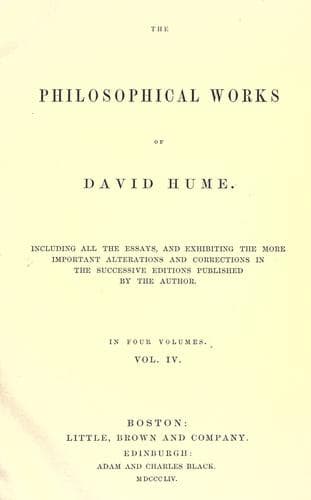
Philosophical Works, v. 1 (of 4): Including All the Essays, and Exhibiting the More Important Alterations and Corrections in the Successive Editions Published by the AuthorHume, David
PhilosophyPhilosophy
Philosophical Works, v. 1 (of 4): Including All the Essays, and Exhibiting the More Important Alterations and Corrections in the Successive Editions Published by the Author
Hume, David
Knowledge, Theory of; Philosophy, English -- 18th century
A fourth unphilosophical species of probability is that derived from
_general rules_, which we rashly form to ourselves, and which are the
source of what we properly call _prejudice_. An Irishman cannot have
wit, and a Frenchman cannot have solidity; for which reason, though the
conversation of the former in any instance be visibly very agreeable,
and of the latter very judicious, we have entertained such a prejudice
against them, that they must be dunces or fops in spite of sense and
reason. Human nature is very subject to errors of this kind, and
perhaps this nation as much as any other.
Should it be demanded why men form general rules, and allow them to
influence their judgment, even contrary to present observation and
experience, I should reply, that in my opinion it proceeds from those
very principles on which all judgments concerning causes and effects
depend. Our judgments concerning cause and effect are derived from
habit and experience; and when we have been accustomed to see one
object united to another, our imagination passes from the first to the
second by a natural transition, which precedes reflection, and which
cannot be prevented by it. Now, 'tis the nature of custom not only
to operate with its full force, when objects are presented that are
exactly the same with those to which we have been accustomed, but also
to operate in an inferior degree when we discover such as are similar;
and though the habit loses somewhat of its force by every difference,
yet 'tis seldom entirely destroyed where any considerable circumstances
remain the same. A man who has contracted a custom of eating fruit by
the use of pears or peaches, will satisfy himself with melons where he
cannot find his favourite fruit; as one, who has become a drunkard by
the use of red wines, will be carried almost with the same violence to
white, if presented to him. From this principle I have accounted for
that species of probability, derived from analogy, where we transfer
our experience in past instances to objects which are resembling,
but are not exactly the same with those concerning which we have had
experience. In proportion as the resemblance decays, the probability
diminishes, but still has some force as long as there remain any traces
of the resemblance.
Public-domain text, read in full here on John Shaqi.
Reviews
Reviews
No reviews yet
Be the first to share your thoughts on this work.
Elsewhere in the archive
Join the Discussion
Join the discussion
Sign in to leave a comment or review.
Sign InorCreate an account