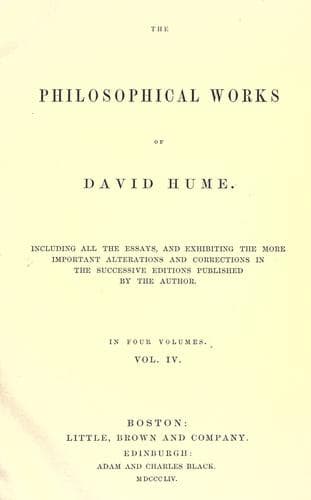
Philosophical Works, v. 1 (of 4): Including All the Essays, and Exhibiting the More Important Alterations and Corrections in the Successive Editions Published by the AuthorHume, David
PhilosophyPhilosophy
Philosophical Works, v. 1 (of 4): Including All the Essays, and Exhibiting the More Important Alterations and Corrections in the Successive Editions Published by the Author
Hume, David
Knowledge, Theory of; Philosophy, English -- 18th century
Thus it appears, upon the whole, that every kind of opinion or
judgment which amounts not to knowledge, is derived entirely from
the force and vivacity of the perception, and that these qualities
constitute in the mind what we call the _belief_ of the existence
of any object. This force and this vivacity are most conspicuous in
the memory; and therefore our confidence in the veracity of that
faculty is the greatest imaginable, and equals in many respects the
assurance of a demonstration. The next degree of these qualities is
that derived from the relation of cause and effect; and this too is
very great, especially when the conjunction is found by experience
to be perfectly constant, and when the object, which is present to
us, exactly resembles those, of which we have had experience. But
below this degree of evidence there are many others, which have an
influence on the passions and imagination, proportioned to that degree
of force and vivacity, which they communicate to the ideas. 'Tis by
habit we make the transition from cause to effect; and 'tis from some
present impression we borrow that vivacity, which we diffuse over the
correlative idea. But when we have not observed a sufficient number
of instances to produce a strong habit; or when these instances are
contrary to each other; or when the resemblance is not exact; or the
present impression is faint and obscure; or the experience in some
measure obliterated from the memory; or the connexion dependent on a
long chain of objects; or the inference derived from general rules,
and yet not conformable to them: in all these cases the evidence
diminishes by the diminution of the force and intenseness of the idea.
This therefore is the nature of the judgment and probability.
Public-domain text, read in full here on John Shaqi.
Reviews
Reviews
No reviews yet
Be the first to share your thoughts on this work.
Elsewhere in the archive
Join the Discussion
Join the discussion
Sign in to leave a comment or review.
Sign InorCreate an account