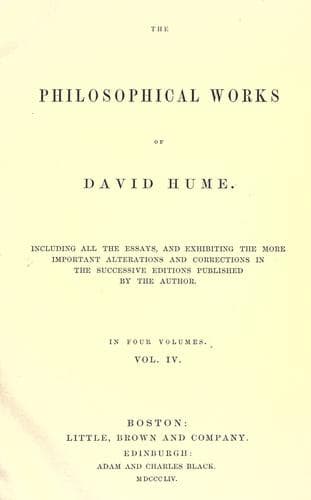
Philosophical Works, v. 1 (of 4): Including All the Essays, and Exhibiting the More Important Alterations and Corrections in the Successive Editions Published by the AuthorHume, David
PhilosophyPhilosophy
Philosophical Works, v. 1 (of 4): Including All the Essays, and Exhibiting the More Important Alterations and Corrections in the Successive Editions Published by the Author
Hume, David
Knowledge, Theory of; Philosophy, English -- 18th century
In this research, we meet with very little encouragement from
that prodigious diversity which is found in the opinions of those
philosophers who have pretended to explain the secret force and
energy of causes.[14] There are some who maintain, that bodies operate
by their substantial form; others, by their accidents or qualities;
several, by their matter and form; some, by their form and accidents;
others, by certain virtues and faculties distinct from all this.
All these sentiments, again, are mixed and varied in a thousand
different ways, and form a strong presumption that none of them have
any solidity or evidence, and that the supposition of an efficacy in
any of the known qualities of matter is entirely without foundation.
This presumption must increase upon us, when we consider, that these
principles of substantial forms, and accidents, and faculties, are not
in reality any of the known properties of bodies, but are perfectly
unintelligible and inexplicable. For 'tis evident philosophers would
never have had recourse to such obscure and uncertain principles, had
they met with any satisfaction in such as are clear and intelligible;
especially in such an affair as this, which must be an object of the
simplest understanding, if not of the senses. Upon the whole, we may
conclude, that 'tis impossible, in any one instance, to show the
principle in which the force and agency of a cause is placed; and
that the most refined and most vulgar understandings are equally at
a loss in this particular. If any one think proper to refute this
assertion, he need not put himself to the trouble of inventing any long
reasonings, but may at once show us an instance of a cause, where we
discover the power or operating principle. This defiance we are obliged
frequently to make use of, as being almost the only means of proving a
negative in philosophy.
The small success which has been met with in all the attempts to fix
this power, has at last obliged philosophers to conclude, that the
ultimate force and efficacy of nature is perfectly unknown to us,
and that 'tis in vain we search for it in all the known qualities of
matter. In this opinion they are almost unanimous; and 'tis only in
the inference they draw from it, that they discover any difference in
their sentiments. For some of them, as the Cartesians in particular,
having established it as a principle, that we are perfectly acquainted
with the essence of matter, have very naturally inferred, that it is
endowed with no efficacy, and that 'tis impossible for it of itself to
communicate motion, or produce any of those effects, which we ascribe
to it. As the essence of matter consists in extension, and as extension
implies not actual motion, but only mobility; they conclude, that the
energy, which produces the motion, cannot lie in the extension.
Public-domain text, read in full here on John Shaqi.
Reviews
Reviews
No reviews yet
Be the first to share your thoughts on this work.
Elsewhere in the archive
Join the Discussion
Join the discussion
Sign in to leave a comment or review.
Sign InorCreate an account