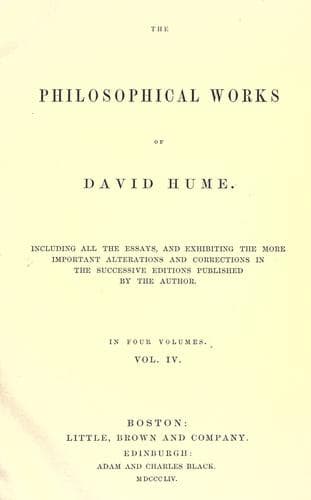
Philosophical Works, v. 1 (of 4): Including All the Essays, and Exhibiting the More Important Alterations and Corrections in the Successive Editions Published by the AuthorHume, David
PhilosophyPhilosophy
Philosophical Works, v. 1 (of 4): Including All the Essays, and Exhibiting the More Important Alterations and Corrections in the Successive Editions Published by the Author
Hume, David
Knowledge, Theory of; Philosophy, English -- 18th century
I can only reply to all these arguments, that the case is here much the
same, as if a blind man should pretend to find a great many absurdities
in the supposition, that the colour of scarlet is not the same with the
sound of a trumpet, nor light the same with solidity. If we have really
no idea of a power or efficacy in any object, or of any real connexion
betwixt causes and effects, 'twill be to little purpose to prove,
that an efficacy is necessary in all operations. We do not understand
our own meaning in talking so, but ignorantly confound ideas which
are entirely distinct from each other. I am, indeed, ready to allow,
that there may be several qualities, both in material and immaterial
objects, with which we are utterly unacquainted; and if we please to
call these _power_ or _efficacy_,'twill be of little consequence to the
world. But when, instead of meaning these unknown qualities, we make
the terms of power and efficacy signify something, of which we have a
clear idea, and which is incompatible with those objects to which we
apply it, obscurity and error begin then to take place, and we are led
astray by a false philosophy. This is the case when we transfer the
determination of the thought to external objects, and suppose any real
intelligible connexion betwixt them; that being a quality which can
only belong to the mind that considers them.
As to what may be said, that the operations of nature are independent
of our thought and reasoning, I allow it; and accordingly have
observed, that objects bear to each other the relations of contiguity
and succession; that like objects may be observed, in several
instances, to have like relations; and that all this is independent
of, and antecedent to, the operations of the understanding. But if we
go any farther, and ascribe a power or necessary connexion to these
objects, this is what we can never observe in them, but must draw the
idea of it from what we feel internally in contemplating them. And this
I carry so far, that I am ready to convert my present reasoning into
an instance of it, by a subtility which it will not be difficult to
comprehend.
Public-domain text, read in full here on John Shaqi.
Reviews
Reviews
No reviews yet
Be the first to share your thoughts on this work.
Elsewhere in the archive
Join the Discussion
Join the discussion
Sign in to leave a comment or review.
Sign InorCreate an account