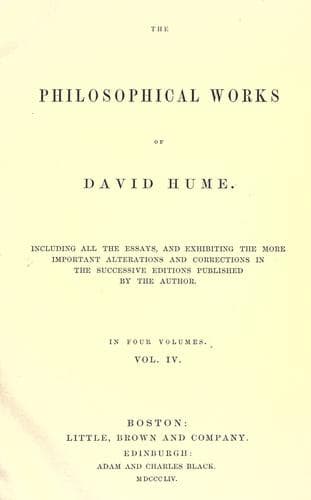
Philosophical Works, v. 1 (of 4): Including All the Essays, and Exhibiting the More Important Alterations and Corrections in the Successive Editions Published by the AuthorHume, David
PhilosophyPhilosophy
Philosophical Works, v. 1 (of 4): Including All the Essays, and Exhibiting the More Important Alterations and Corrections in the Successive Editions Published by the Author
Hume, David
Knowledge, Theory of; Philosophy, English -- 18th century
There may two definitions be given of this relation, which are only
different by their presenting a different view of the same object, and
making us consider it either as a _philosophical_ or as a _natural_
relation; either as a comparison of two ideas, or as an association
betwixt them. We may define a _cause_ to be "An object precedent and
contiguous to another, and where all the objects resembling the former
are placed in like relations of precedency and contiguity to those
objects that resemble the latter." If this definition be esteemed
defective, because drawn from objects foreign to the cause, we may
substitute this other definition in its place, viz. "A _cause_ is an
object precedent and contiguous to another, and so united with it that
the idea of the one determines the mind to form the idea of the other,
and the impression of the one to form a more lively idea of the other."
Should this definition also be rejected for the same reason, I know no
other remedy, than that the persons who express this delicacy should
substitute a juster definition in its place. But, for my part, I must
own my incapacity for such an undertaking. When I examine, with the
utmost accuracy, those objects which are commonly denominated causes
and effects, I find, in considering a single instance, that the one
object is precedent and contiguous to the other; and in enlarging my
view to consider several instances, I find only that like objects are
constantly placed in like relations of succession and contiguity.
Again, when I consider the influence of this constant conjunction, I
perceive that such a relation can never be an object of reasoning,
and can never operate upon the mind but by means of custom, which
determines the imagination to make a transition from the idea of one
object to that of its usual attendant, and from the impression of
one to a more lively idea of the other. However extraordinary these
sentiments may appear, I think it fruitless to trouble myself with any
farther inquiry or reasoning upon the subject, but shall repose myself
on them as on established maxims.
Public-domain text, read in full here on John Shaqi.
Reviews
Reviews
No reviews yet
Be the first to share your thoughts on this work.
Elsewhere in the archive
Join the Discussion
Join the discussion
Sign in to leave a comment or review.
Sign InorCreate an account