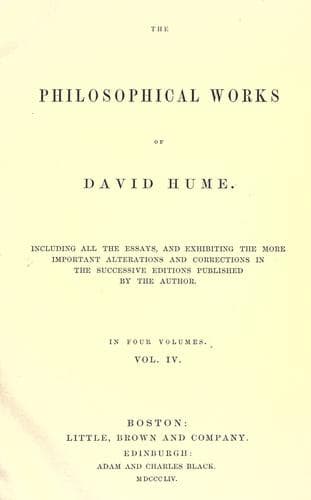
Philosophical Works, v. 1 (of 4): Including All the Essays, and Exhibiting the More Important Alterations and Corrections in the Successive Editions Published by the AuthorHume, David
PhilosophyPhilosophy
Philosophical Works, v. 1 (of 4): Including All the Essays, and Exhibiting the More Important Alterations and Corrections in the Successive Editions Published by the Author
Hume, David
Knowledge, Theory of; Philosophy, English -- 18th century
will make this observation bear the air of an apology rather than of
boasting.
If any thing can give me security in this particular, 'twill be the
enlarging the sphere of my experiments as much as possible; for which
reason, it may be proper, in this place, to examine the reasoning
faculty of brutes, as well as that of human creatures.
[18] Part I. Sect 5.
SECTION XVI.
OF THE REASON OF ANIMALS.
Next to the ridicule of denying an evident truth, is that of taking
much pains to defend it; and no truth appears to me more evident, than
that the beasts are endowed with thought and reason as well as men. The
arguments are in this case so obvious, that they never escape the most
stupid and ignorant.
We are conscious, that we ourselves, in adapting means to ends, are
guided by reason and design, and that 'tis not ignorantly nor casually
we perform those actions which tend to self-preservation, to the
obtaining pleasure, and avoiding pain. When, therefore, we see other
creatures, in millions of instances, perform like actions, and direct
them to like ends, all our principles of reason and probability carry
us with an invincible force to believe the existence of a like cause.
'Tis needless, in my opinion, to illustrate this argument by the
enumeration of particulars. The smallest attention will supply us with
more than are requisite. The resemblance betwixt the actions of animals
and those of men is so entire, in this respect, that the very first
action of the first animal we shall please to pitch on, will afford us
an incontestable argument for the present doctrine.
This doctrine is as useful as it is obvious, and furnishes us with a
kind of touchstone, by which we may try every system in this species
of philosophy. 'Tis from the resemblance of the external actions of
animals to those we ourselves perform, that we judge their internal
likewise to resemble ours; and the same principle of reasoning, carried
one step farther, will make us conclude, that, since our internal
actions resemble each other, the causes, from which they are derived,
must also be resembling. When any hypothesis, therefore, is advanced to
explain a mental operation, which is common to men and beasts, we must
apply the same hypothesis to both; and as every true hypothesis will
abide this trial, so I may venture to affirm, that no false one will
ever be able to endure it. The common defect of those systems, which
philosophers have employed to account for the actions of the mind, is,
that they suppose such a subtility and refinement of thought, as not
only exceeds the capacity of mere animals, but even of children and the
common people in our own species; who are, notwithstanding, susceptible
of the same emotions and affections as persons of the most accomplished
genius and understanding. Such a subtility is a clear proof of the
falsehood, as the contrary simplicity of the truth, of any system.
Public-domain text, read in full here on John Shaqi.
Reviews
Reviews
No reviews yet
Be the first to share your thoughts on this work.
Elsewhere in the archive
Join the Discussion
Join the discussion
Sign in to leave a comment or review.
Sign InorCreate an account