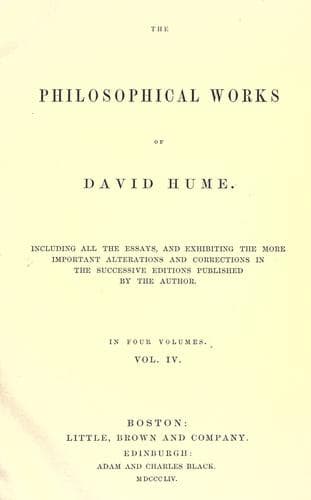
Philosophical Works, v. 1 (of 4): Including All the Essays, and Exhibiting the More Important Alterations and Corrections in the Successive Editions Published by the AuthorHume, David
PhilosophyPhilosophy
Philosophical Works, v. 1 (of 4): Including All the Essays, and Exhibiting the More Important Alterations and Corrections in the Successive Editions Published by the Author
Hume, David
Knowledge, Theory of; Philosophy, English -- 18th century
This I take to be the true state of the question, and cannot approve
of that expeditious way, which some take with the sceptics, to reject
at once all their arguments without inquiry or examination. If the
sceptical reasonings be strong, say they, 'tis a proof that reason may
have some force and authority: if weak, they can never be sufficient
to invalidate all the conclusions of our understanding. This argument
is not just; because the sceptical reasonings, were it possible for
them to exist, and were they not destroyed by their subtilty, would
be successively both strong and weak, according to the successive
dispositions of the mind. Reason first appears in possession of the
throne, prescribing laws, and imposing maxims, with an absolute sway
and authority. Her enemy, therefore, is obliged to take shelter under
her protection, and by making use of rational arguments to prove the
fallaciousness and imbecility of reason, produces, in a manner, a
patent under her hand and seal. This patent has at first an authority,
proportioned to the present and immediate authority of reason, from
which it is derived. But as it is supposed to be contradictory to
reason, it gradually diminishes the force of that governing power and
its own at the same time; till at last they both vanish away into
nothing, by a regular and just diminution. The sceptical and dogmatical
reasons are of the same kind, though contrary in their operation and
tendency; so that where the latter is strong, it has an enemy of equal
force in the former to encounter; and as their forces were at first
equal, they still continue so, as long as either of them subsists; nor
does one of them lose any force in the contest, without taking as much
from its antagonist. 'Tis happy, therefore, that nature breaks the
force of all sceptical arguments in time, and keeps them from having
any considerable influence on the understanding. Were we to trust
entirely to their self-destruction, that can never take place, 'till
they have first subverted all conviction, and have totally destroyed
human reason.
SECTION II.
OF SCEPTICISM WITH REGARD TO THE SENSES.
Thus the sceptic still continues to reason and believe, even though he
asserts that he cannot defend his reason by reason; and by the same
rule he must assent to the principle concerning the existence of body,
though he cannot pretend, by any arguments of philosophy, to maintain
its veracity. Nature has not left this to his choice, and has doubtless
esteemed it an affair of too great importance, to be trusted to our
uncertain reasonings and speculations. We may well ask, _What causes
induce us to believe in the existence of body_? but 'tis in vain to
ask, _Whether there be body or not_? That is a point, which we must
take for granted in all our reasonings.
Public-domain text, read in full here on John Shaqi.
Reviews
Reviews
No reviews yet
Be the first to share your thoughts on this work.
Elsewhere in the archive
Join the Discussion
Join the discussion
Sign in to leave a comment or review.
Sign InorCreate an account