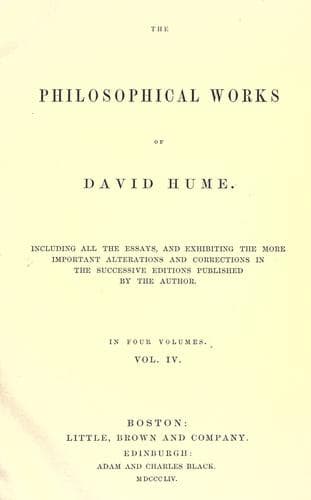
Philosophical Works, v. 1 (of 4): Including All the Essays, and Exhibiting the More Important Alterations and Corrections in the Successive Editions Published by the AuthorHume, David
PhilosophyPhilosophy
Philosophical Works, v. 1 (of 4): Including All the Essays, and Exhibiting the More Important Alterations and Corrections in the Successive Editions Published by the Author
Hume, David
Knowledge, Theory of; Philosophy, English -- 18th century
When we have been accustomed to observe a constancy in certain
impressions, and have found that the perception of the sun or ocean,
for instance, returns upon us, after an absence or annihilation, with
like parts and in a like order as at its first appearance, we are not
apt to regard these interrupted perceptions as different (which they
really are), but on the contrary consider them as individually the
same, upon account of their resemblance. But as this interruption of
their existence is contrary to their perfect identity, and makes us
regard the first impression as annihilated, and the second as newly
created, we find ourselves somewhat at a loss, and are involved in a
kind of contradiction. In order to free ourselves from this difficulty,
we disguise, as much as possible, the interruption, or rather remove it
entirely, by supposing that these interrupted perceptions are connected
by a real existence, of which we are insensible. This supposition, or
idea of continued existence, acquires a force and vivacity from the
memory of these broken impressions, and from that propensity which
they give us to suppose them the same; and according to the precedent
reasoning, the very essence of belief consists in the force and
vivacity of the conception.
In order to justify this system, there are four things requisite.
_First_, to explain the _principium individuations_, or principle of
identity. _Secondly_, give a reason why the resemblance of our broken
and interrupted perceptions induces us to attribute an identity to
them. _Thirdly_, account for that propensity, which this allusion
gives, to unite these broken appearances by a continued existence.
_Fourthly_, and lastly, explain that force and vivacity of conception
which arises from the propensity.
First, as to the principle of individuation, we may observe, that
the view of any one object is not sufficient to convey the idea of
identity. For in that proposition, _an object is the same with itself_,
if the idea expressed by the word _object_ were no ways distinguished
from that meant by _itself_; we really should mean nothing, nor would
the proposition contain a predicate and a subject, which, however, are
implied in this affirmation. One single object conveys the idea of
unity, not that of identity.
On the other hand, a multiplicity of objects can never convey this
idea, however resembling they may be supposed. The mind always
pronounces the one not to be the other, and considers them as forming
two, three, or any determinate number of objects, whose existences are
entirely distinct and independent.
Public-domain text, read in full here on John Shaqi.
Philosophical Works, v. 1 (of 4): Including All the Essays, and Exhibiting the More Important Alterations and Corrections in the Successive Editions Published by the Author — John Shaqi
Reviews
Reviews
No reviews yet
Be the first to share your thoughts on this work.
Elsewhere in the archive
Join the Discussion
Join the discussion
Sign in to leave a comment or review.
Sign InorCreate an account