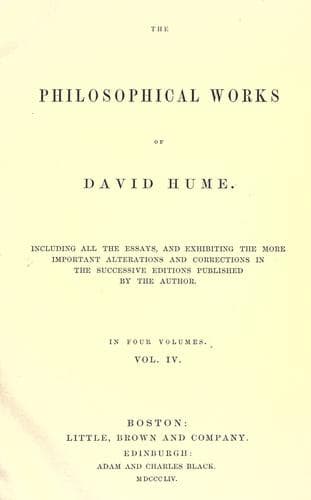
Philosophical Works, v. 1 (of 4): Including All the Essays, and Exhibiting the More Important Alterations and Corrections in the Successive Editions Published by the AuthorHume, David
PhilosophyPhilosophy
Philosophical Works, v. 1 (of 4): Including All the Essays, and Exhibiting the More Important Alterations and Corrections in the Successive Editions Published by the Author
Hume, David
Knowledge, Theory of; Philosophy, English -- 18th century
But though our natural and obvious principles here prevail above our
studied reflections, 'tis certain there must be some struggle and
opposition in the case; at least so long as these reflections retain
any force or vivacity. In order to set ourselves at ease in this
particular, we contrive a new hypothesis, which seems to comprehend
both these principles of reason and imagination. This hypothesis is the
philosophical one of the double existence of perceptions and objects;
which pleases our reason, in allowing that our dependent perceptions
are interrupted and different, and at the same time is agreeable to
the imagination, in attributing a continued existence to something
else, which we call _objects_. This philosophical system, therefore,
is the monstrous offspring of two principles, which are contrary to
each other, which are both at once embraced by the mind, and which
are unable mutually to destroy each other. The imagination tells us,
that our resembling perceptions have a continued and uninterrupted
existence, and are not annihilated by their absence. Reflection tells
us, that even our resembling perceptions are interrupted in their
existence, and different from each other. The contradiction betwixt
these opinions we elude by a new fiction, which is conformable to the
hypotheses both of reflection and fancy, by ascribing these contrary
qualities to different existences; the _interruption_ to perceptions,
and the _continuance_ to objects. Nature is obstinate, and will not
quit the field, however strongly attacked by reason; and at the same
time reason is so clear in the point, that there is no possibility
of disguising her. Not being able to reconcile these two enemies, we
endeavour to set ourselves at ease as much as possible, by successively
granting to each whatever it demands, and by feigning a double
existence, where each may find something that has all the conditions it
desires. Were we fully convinced that our resembling perceptions are
continued, and identical, and independent, we should never run into
this opinion of a double existence; since we should find satisfaction
in our first supposition, and would not look beyond. Again, were we
fully convinced that our perceptions are dependent, and interrupted,
and different, we should be as little inclined to embrace the opinion
of a double existence; since in that case we should clearly perceive
the error of our first supposition of a continued existence, and would
never regard it any farther. 'Tis therefore from the intermediate
situation of the mind that this opinion arises, and from such an
adherence to these two contrary principles, as makes us seek some
pretext to justify our receiving both; which happily at last is found
in the system of a double existence.
Public-domain text, read in full here on John Shaqi.
Reviews
Reviews
No reviews yet
Be the first to share your thoughts on this work.
Elsewhere in the archive
Join the Discussion
Join the discussion
Sign in to leave a comment or review.
Sign InorCreate an account