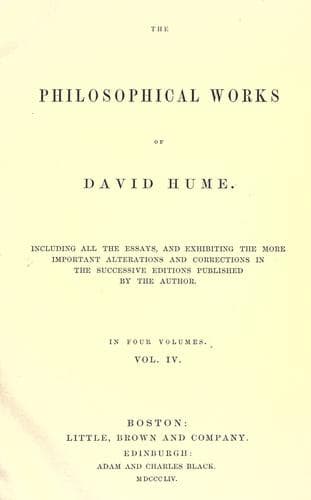
Philosophical Works, v. 1 (of 4): Including All the Essays, and Exhibiting the More Important Alterations and Corrections in the Successive Editions Published by the AuthorHume, David
PhilosophyPhilosophy
Philosophical Works, v. 1 (of 4): Including All the Essays, and Exhibiting the More Important Alterations and Corrections in the Successive Editions Published by the Author
Hume, David
Knowledge, Theory of; Philosophy, English -- 18th century
This sceptical doubt, both with respect to reason and the senses, is
a malady which can never be radically cured, but must return upon us
every moment, however we may chase it away, and sometimes may seem
entirely free from it. 'Tis impossible, upon any system, to defend
either our understanding or senses; and we but expose them farther
when we endeavour to justify them in that manner. As the sceptical
doubt arises naturally from a profound and intense reflection on those
subjects, it always increases the farther we carry our reflections,
whether in opposition or conformity to it. Carelessness and inattention
alone can afford us any remedy. For this reason I rely entirely upon
them; and take it for granted, whatever may be the reader's opinion at
this present moment, that an hour hence he will be persuaded there is
both an external and internal world; and, going upon that supposition,
I intend to examine some general systems, both ancient and modern,
which have been proposed of both, before I proceed to a more particular
inquiry concerning our impressions. This will not, perhaps, in the end,
be found foreign to our present purpose.
[1] Part II. Sect. 6.
[2] Sect. 5.
[3] Part II. Sect. 4.
[4] Part II. Sect. 5.
[5] Part. II. Sect. 5.
[6] This reasoning, it must be confessed, is somewhat abstruse, and
difficult to be comprehended; but it is remarkable, that this very
difficulty may be converted into a proof of the reasoning. We may
observe, that there are two relations, and both of them resemblances,
which contribute to our mistaking the succession of our interrupted
perceptions for an identical object. The first is, the resemblance of
the perceptions: the second is, the resemblance which the act of the
mind in surveying a succession of resembling objects, bears to that in
surveying an identical object. Now these resemblances we are apt to
confound with each other; and 'tis natural we should, according to this
very reasoning. But let us keep them distinct, and we shall find no
difficulty in conceiving the precedent argument.
[7] Sect. 6.
[8] Sect. 5.
SECTION III.
OF THE ANCIENT PHILOSOPHY.
Public-domain text, read in full here on John Shaqi.
Reviews
Reviews
No reviews yet
Be the first to share your thoughts on this work.
Elsewhere in the archive
Join the Discussion
Join the discussion
Sign in to leave a comment or review.
Sign InorCreate an account