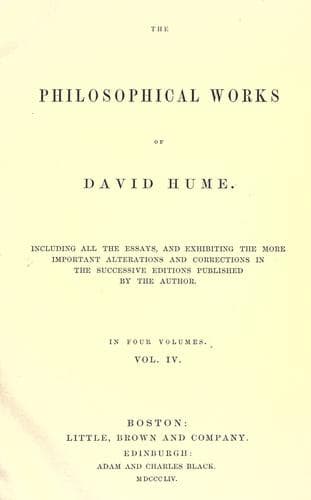
Philosophical Works, v. 1 (of 4): Including All the Essays, and Exhibiting the More Important Alterations and Corrections in the Successive Editions Published by the AuthorHume, David
PhilosophyPhilosophy
Philosophical Works, v. 1 (of 4): Including All the Essays, and Exhibiting the More Important Alterations and Corrections in the Successive Editions Published by the Author
Hume, David
Knowledge, Theory of; Philosophy, English -- 18th century
But when we alter our method of considering the succession, and,
instead of tracing it gradually through the successive points of time,
survey at once any two distinct periods of its duration, and compare
the different conditions of the successive qualities; in that case
the variations, which were insensible when they arose gradually, do
now appear of consequence, and seem entirely to destroy the identity.
By this means there arises a kind of contrariety in our method of
thinking, from the different points of view, in which we survey the
object, and from the nearness or remoteness of those instants of time,
which we compare together. When we gradually follow an object in its
successive changes, the smooth progress of the thought makes us ascribe
an identity to the succession; because 'tis by a similar act of the
mind we consider an unchangeable object. When we compare its situation
after a considerable change the progress of the thought is broke; and
consequently we are presented with the idea of diversity; in order
to reconcile which contradictions the imagination is apt to feign
something unknown and invisible, which it supposes to continue the same
under all these variations; and this unintelligible something it calls
a _substance, or original and first matter_.
We entertain a like notion with regard to the _simplicity_ of
substances, and from like causes. Suppose an object perfectly simple
and indivisible to be presented, along with another object, whose
_co-existent_ parts are connected together by a strong relation, 'tis
evident the actions of the mind, in considering these two objects, are
not very different. The imagination conceives the simple object at
once, with facility, by a single effort of thought, without change or
variation. The connexion of parts in the compound object has almost the
same effect, and so unites the object within itself, that the fancy
feels not the transition in passing from one part to another. Hence the
colour, taste, figure, solidity, and other qualities, combined in a
peach or melon, are conceived to form _one thing_; and that on account
of their close relation, which makes them affect the thought in the
same manner, as if perfectly uncompounded. But the mind rests not here.
Whenever it views the object in another light, it finds that all these
qualities are different, and distinguishable, and separable from each
other; which view of things being destructive of its primary and more
natural notions, obliges the imagination to feign an unknown something,
or _original_ substance and matter, as a principle of union or cohesion
among these qualities, and as what may give the compound object a title
to be called one thing, notwithstanding its diversity and composition.
Public-domain text, read in full here on John Shaqi.
Reviews
Reviews
No reviews yet
Be the first to share your thoughts on this work.
Elsewhere in the archive
Join the Discussion
Join the discussion
Sign in to leave a comment or review.
Sign InorCreate an account