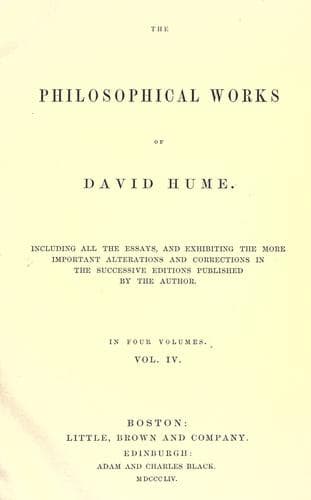
Philosophical Works, v. 1 (of 4): Including All the Essays, and Exhibiting the More Important Alterations and Corrections in the Successive Editions Published by the AuthorHume, David
PhilosophyPhilosophy
Philosophical Works, v. 1 (of 4): Including All the Essays, and Exhibiting the More Important Alterations and Corrections in the Successive Editions Published by the Author
Hume, David
Knowledge, Theory of; Philosophy, English -- 18th century
Nor must we omit, on this occasion, our accustomed method of examining
ideas by considering those impressions from which they are derived.
The impressions which enter by the sight and hearing, the smell and
taste, are affirmed by modern philosophy to be without any resembling
objects; and consequently the idea of solidity, which is supposed to
be real, can never be derived from any of these senses. There remains,
therefore, the feeling as the only sense that can convey the impression
which is original to the idea of solidity; and, indeed, we naturally
imagine that we feel the solidity of bodies, and need but touch any
object in order to perceive this quality. But this method of thinking
is more popular than philosophical, as will appear from the following
reflections.
First, 'tis easy to observe, that though bodies are felt by means
of their solidity, yet the feeling is a quite different thing from
the solidity, and that they have not the least resemblance to each
other. A man who has the palsy in one hand has as perfect an idea of
impenetrability, when he observes that hand to be supported by the
table, as when he feels the same table with the other hand. An object
that presses upon any of our members meets with resistance; and that,
resistance, by the motion it gives to the nerves and animal spirits,
conveys a certain sensation to the mind; but it does not follow that
the sensation, motion and resistance, are any ways resembling.
Secondly, the impressions of touch are simple impressions, except when
considered with regard to their extension; which makes nothing to the
present purpose: and from this simplicity I infer, that they neither
represent solidity, nor any real object. For let us put two cases, viz.
that of a man who presses a stone or any solid body with his hand, and
that of two stones which press each other; 'twill readily be allowed
that these two cases are not in every respect alike, but that in the
former there is conjoined with the solidity a feeling or sensation of
which there is no appearance in the latter. In order, therefore, to
make these two cases alike, 'tis necessary to remove some part of the
impression which the man feels by his hand, or organ of sensation; and
that being impossible in a simple impression, obliges us to remove the
whole, and proves that this whole impression has no archetype or model
in external objects; to which we may add, that solidity necessarily
supposes two bodies, along with contiguity and impulse; which being a
compound object, can never be represented by a simple impression. Not
to mention, that, though solidity continues always invariably the same,
the impressions of touch change every moment upon us, which is a clear
proof that the latter are not representations of the former.
Public-domain text, read in full here on John Shaqi.
Reviews
Reviews
No reviews yet
Be the first to share your thoughts on this work.
Elsewhere in the archive
Join the Discussion
Join the discussion
Sign in to leave a comment or review.
Sign InorCreate an account