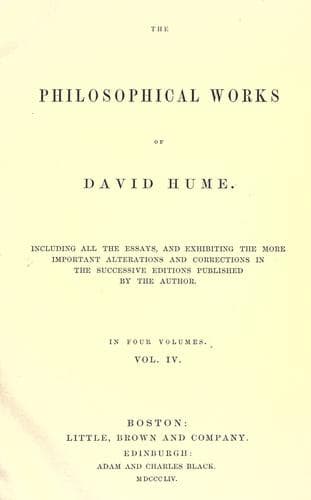
Philosophical Works, v. 1 (of 4): Including All the Essays, and Exhibiting the More Important Alterations and Corrections in the Successive Editions Published by the AuthorHume, David
PhilosophyPhilosophy
Philosophical Works, v. 1 (of 4): Including All the Essays, and Exhibiting the More Important Alterations and Corrections in the Successive Editions Published by the Author
Hume, David
Knowledge, Theory of; Philosophy, English -- 18th century
First, it has been said against Spinoza, according to the scholastic
way of talking, rather than thinking, that a mode, not being any
distinct or separate existence, must be the very same with its
substance, and consequently the extension of the universe must be in
a manner identified with that simple, uncompounded essence in which
the universe is supposed to inhere. But this, it may be pretended, is
utterly impossible and inconceivable unless the indivisible substance
expand itself, so as to correspond to the extension, or the extension
contract itself, so as to answer to the indivisible substance. This
argument seems just, as far as we can understand it; and 'tis plain
nothing is required, but a change in the terms, to apply the same
argument to our extended perceptions, and the simple essence of the
soul; the ideas of objects and perceptions being in every respect the
same, only attended with the supposition of a difference, that is
unknown and incomprehensible.
Secondly, it has been said, that we have no idea of substance, which
is not applicable to matter; nor any idea of a distinct substance,
which is not applicable to every distinct portion of matter. Matter
therefore is not a mode but a substance, and each part of matter is
not a distinct mode, but a distinct substance. I have already proved,
that we have no perfect idea of substance; but that taking it for
_something that can exist by itself_, 'tis evident every perception
is a substance, and every distinct part of a perception a distinct
substance: and consequently the one hypothesis labours under the same
difficulties in this respect with the other.
Thirdly, it has been objected to the system of one simple substance in
the universe, that this substance, being the support or _substratum_
of every thing, must at the very same instant be modified into forms,
which are contrary and incompatible. The round and square figures
are incompatible in the same substance at the same time. How then is
it possible, that the same substance can at once be modified into
that square table, and into this round one? I ask the same question
concerning the impressions of these tables; and find that the answer is
no more satisfactory in one case than in the other.
Public-domain text, read in full here on John Shaqi.
Reviews
Reviews
No reviews yet
Be the first to share your thoughts on this work.
Elsewhere in the archive
Join the Discussion
Join the discussion
Sign in to leave a comment or review.
Sign InorCreate an account