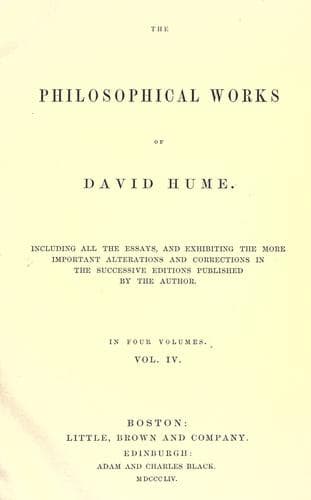
Philosophical Works, v. 1 (of 4): Including All the Essays, and Exhibiting the More Important Alterations and Corrections in the Successive Editions Published by the AuthorHume, David
PhilosophyPhilosophy
Philosophical Works, v. 1 (of 4): Including All the Essays, and Exhibiting the More Important Alterations and Corrections in the Successive Editions Published by the Author
Hume, David
Knowledge, Theory of; Philosophy, English -- 18th century
I am first affrighted and confounded with that forlorn solitude in
which I am placed in my philosophy, and fancy myself some strange
uncouth monster, who, not being able to mingle and unite in society,
has been expelled all human commerce, and left utterly abandoned and
disconsolate. Fain would I run into the crowd for shelter and warmth,
but cannot prevail with myself to mix with such deformity. I call
upon others to join me, in order to make a company apart, but no one
will hearken to me. Every one keeps at a distance, and dreads that
storm which beats upon me from every side. I have exposed myself to
the enmity of all metaphysicians, logicians, mathematicians, and even
theologians; and can I wonder at the insults I must suffer? I have
declared my disapprobation of their systems; and can I be surprised
if they should express a hatred of mine and of my person? When I look
abroad, I foresee on every side dispute, contradiction, anger, calumny
and detraction. When I turn my eye inward, I find nothing but doubt and
ignorance. All the world conspires to oppose and contradict me; though
such is my weakness, that I feel all my opinions loosen and fall of
themselves, when unsupported by the approbation of others. Every step
I take is with hesitation, and every new reflection makes me dread an
error and absurdity in my reasoning.
For with what confidence can I venture upon such bold enterprises,
when, beside those numberless infirmities peculiar to myself, I find so
many which are common to human nature? Can I be sure that, in leaving
all established opinions, I am following truth? and by what criterion
shall I distinguish her, even if fortune should at last guide me on
her footsteps? After the most accurate and exact of my reasonings, I
can give no reason why I should assent to it, and feel nothing but a
_strong_ propensity to consider objects _strongly_ in that view under
which they appear to me. Experience is a principle which instructs me
in the several conjunctions of objects for the past. Habit is another
principle which determines me to expect the same for the future; and
both of them conspiring to operate upon the imagination, make me form
certain ideas in a more intense and lively manner than others which
are not attended with the same advantages. Without this quality, by
which the mind enlivens some ideas beyond others (which seemingly is so
trivial, and so little founded on reason), we could never assent to any
argument, nor carry our view beyond those few objects which are present
to our senses. Nay, even to these objects we could never attribute any
existence but what was dependent on the senses, and must comprehend
them entirely in that succession of perceptions which constitutes our
self or person. Nay, farther, even with relation to that succession, we
could only admit of those perceptions which are immediately present to
our consciousness; nor could those lively images, with which the memory
Public-domain text, read in full here on John Shaqi.
Reviews
Reviews
No reviews yet
Be the first to share your thoughts on this work.
Elsewhere in the archive
Join the Discussion
Join the discussion
Sign in to leave a comment or review.
Sign InorCreate an account