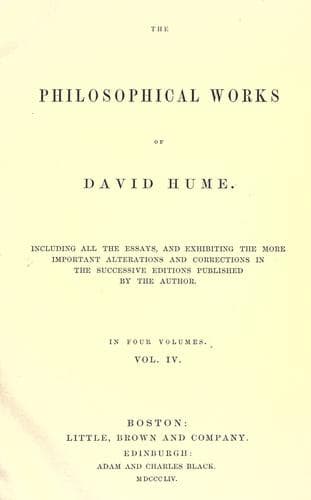
Philosophical Works, v. 1 (of 4): Including All the Essays, and Exhibiting the More Important Alterations and Corrections in the Successive Editions Published by the AuthorHume, David
PhilosophyPhilosophy
Philosophical Works, v. 1 (of 4): Including All the Essays, and Exhibiting the More Important Alterations and Corrections in the Successive Editions Published by the Author
Hume, David
Knowledge, Theory of; Philosophy, English -- 18th century
This deficiency in our ideas is not indeed perceived in common life,
nor are we sensible that, in the most usual conjunctions of cause and
effect, we are as ignorant of the ultimate principle which binds them
together, as in the most unusual and extraordinary. But this proceeds
merely from an illusion of the imagination; and the question is,
how far we ought to yield to these illusions. This question is very
difficult, and reduces us to a very dangerous dilemma, whichever way we
answer it. For if we assent to every trivial suggestion of the fancy,
beside that these suggestions are often contrary to each other, they
lead us into such errors, absurdities, and obscurities, that we must
at last become ashamed of our credulity. Nothing is more dangerous to
reason than the flights of the imagination, and nothing has been the
occasion of more mistakes among philosophers. Men of bright fancies
may in this respect be compared to those angels, whom the Scripture
represents as covering their eyes with their wings. This has already
appeared in so many instances, that we may spare ourselves the trouble
of enlarging upon it any farther.
But, on the other hand, if the consideration of these instances makes
us take a resolution to reject all the trivial suggestions of the
fancy, and adhere to the understanding, that is, to the general and
more established properties of the imagination; even this resolution,
if steadily executed, would be dangerous, and attended with the
most fatal consequences. For I have already shown,[19] that the
understanding, when it acts alone, and according to its most general
principles, entirely subverts itself, and leaves not the lowest degree
of evidence in any proposition, either in philosophy or common life.
We save ourselves from this total scepticism only by means of that
singular and seemingly trivial property of the fancy, by which we
enter with difficulty into remote views of things, and are not able to
accompany them with so sensible an impression, as we do those which
are more easy and natural. Shall we, then, establish it for a general
maxim, that no refined or elaborate reasoning is ever to be received?
Consider well the consequences of such a principle. By this means you
cut off entirely all science and philosophy: you proceed upon one
singular quality of the imagination, and by a parity of reason must
embrace all of them: and you expressly contradict yourself; since this
maxim must be built on the preceding reasoning, which will be allowed
to be sufficiently refined and metaphysical. What party, then, shall
we choose among these difficulties? If we embrace this principle,
and condemn all refined reasoning, we run into the most manifest
absurdities. If we reject it in favour of these reasonings, we subvert
entirely the human understanding. We have therefore no choice left,
but betwixt a false reason and none at all. For my part, I know not
what ought to be done in the present case. I can only observe what
Public-domain text, read in full here on John Shaqi.
Reviews
Reviews
No reviews yet
Be the first to share your thoughts on this work.
Elsewhere in the archive
Join the Discussion
Join the discussion
Sign in to leave a comment or review.
Sign InorCreate an account