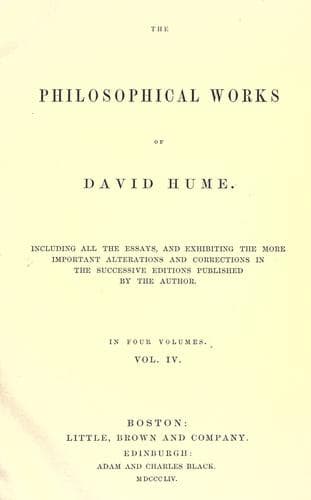
Philosophical Works, v. 1 (of 4): Including All the Essays, and Exhibiting the More Important Alterations and Corrections in the Successive Editions Published by the AuthorHume, David
PhilosophyPhilosophy
Philosophical Works, v. 1 (of 4): Including All the Essays, and Exhibiting the More Important Alterations and Corrections in the Successive Editions Published by the Author
Hume, David
Knowledge, Theory of; Philosophy, English -- 18th century
It is with the greatest surprise I learn, from Mr Hume, that Mr
Rousseau accuses me of being the author of the ironical letter
addressed to him, in the public papers, under the name of the King of
Prussia. Every body knows, both at Paris and London, that such letter
was written by Mr Walpole; nor does he disown it. He acknowledges only
that he was a little assisted, in regard to the style, by a person he
does not name, and whom perhaps he ought to name. As to my part, on
whom the public suspicions have fallen in this affair, I am not at
all acquainted with Mr Walpole. I don't even believe I ever spoke to
him; having only happened to meet once occasionally on a visit. I have
not only had not the least to do, either directly or indirectly, with
the letter in question, but could mention above a hundred persons,
among the friends as well as enemies of Mr Rousseau, who have heard me
greatly disapprove of it; because, as I said, we ought not to ridicule
the unfortunate, especially when they do us no harm. Besides, my
respect for the King of Prussia, and the acknowledgments I owe him,
might, I should have thought, have persuaded Mr Rousseau that I should
not have taken such a liberty with the name of that Prince, though in
pleasantry.
To this I shall add, that I never was an enemy to Mr Rousseau, either
open or secret, as he pretends; and I defy him to produce the least
proof of my having endeavoured to injure him in any shape whatever. I
can prove to the contrary, by the most respectable witnesses, that I
have always endeavoured to oblige him, whenever it lay in my power.
As to my pretended _secret correspondence_ with Mr Hume, it is very
certain that we did not begin to write to each other till about five
or six months after his departure, on occasion of the quarrel arisen
between him and Mr Rousseau, and into which the latter thought proper
unnecessarily to introduce me.
I thought this declaration necessary for my own sake, as well as for
the sake of truth, and in regard to the situation of Mr Rousseau. I
sincerely lament his having so little confidence in the probity of
mankind, and particularly in that of Mr Hume.
D'ALEMBERT.
SCOTTICISMS.
_Will_, in the first person, as _I will walk_, _we will walk_,
expresses the intention or resolution of the person, along with the
future event: In the second and third person, as, _you will_, _he
will_, _they will_, it expresses the future action or event, without
comprehending or excluding the volition.
_Shall_, in the first person, whether singular or plural, expresses
the future action or event, without excluding or comprehending the
intention or resolution: But in the _second_ or _third_ person, it
marks a necessity, and commonly a necessity proceeding from the person
who speaks; as, _he shall walk_, _you shall repent it_.
Public-domain text, read in full here on John Shaqi.
Reviews
Reviews
No reviews yet
Be the first to share your thoughts on this work.
Elsewhere in the archive
Join the Discussion
Join the discussion
Sign in to leave a comment or review.
Sign InorCreate an account