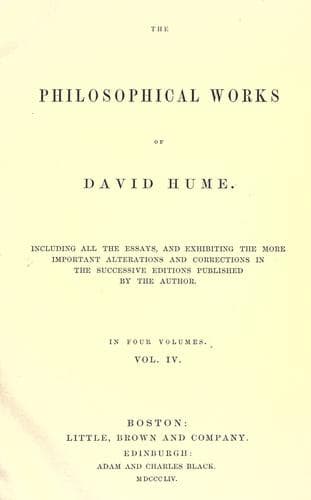
Philosophical Works, v. 1 (of 4): Including All the Essays, and Exhibiting the More Important Alterations and Corrections in the Successive Editions Published by the AuthorHume, David
PhilosophyPhilosophy
Philosophical Works, v. 1 (of 4): Including All the Essays, and Exhibiting the More Important Alterations and Corrections in the Successive Editions Published by the Author
Hume, David
Knowledge, Theory of; Philosophy, English -- 18th century
These variations seem to have proceeded from a politeness in the
_English_, who, in speaking to others, or of others, made use of the
term _will_, which implies volition, even where the event may be the
subject of necessity and constraint. And in speaking of themselves,
made use of the term _shall_, which implies constraint, even though the
event may be the object of choice.
_Wou'd_ and _shou'd_ are conjunctive moods, subject to the same rule;
only, we may observe, that in a sentence, where there is a condition
exprest, and a consequence of that condition, the former always
requires _shou'd_, and the latter _wou'd_, in the second and third
persons; as, _if he shou'd fall, he wou'd break his leg_, &c.
_These_ is the plural of _this_; _those of that_. The former,
therefore, expresses what is near: the latter, what is more remote. As,
in these lines of the Duke of Buckingham,
"Philosophers and poets vainly strove,
In every age, the lumpish mass to move.
But THOSE were pedants if compared with THESE,
Who knew not only to instruct, but please."
Where a relative is to follow, and the subject has not been mentioned
immediately before, _those_ is always required. _Those observations
which he made_. _Those kingdoms which Alexander conquered_.
In the verbs, which end in _t_, or _te_, we frequently omit _ed_ in
the preterperfect and in the participle; as, _he operate_, _it was
cultivate_. _Milton_ says, _in thought more elevate_; but he is the
only author who uses that expression.
_Notice_ shou'd not be used as a verb. The proper phrase is _take
notice_. Yet I find Lord Shaftesbury uses _notic'd_, the participle:
And _unnotic'd_ is very common.
_Hinder to do_, is _Scotch_. The _English_ phrase is, _hinder from
doing_. Yet _Milton_ says, _Hindered not Satan to pervert the mind_.
Book IX.
SCOTCH. ENGLISH.
Public-domain text, read in full here on John Shaqi.
Reviews
Reviews
No reviews yet
Be the first to share your thoughts on this work.
Elsewhere in the archive
Join the Discussion
Join the discussion
Sign in to leave a comment or review.
Sign InorCreate an account