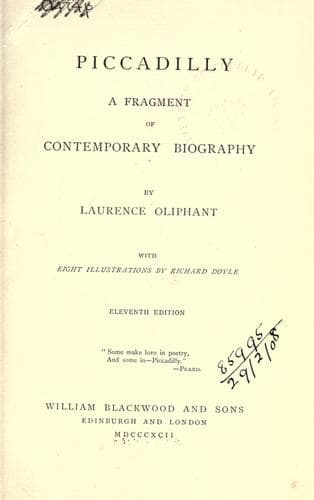
Piccadilly: A Fragment of Contemporary BiographyOliphant, Laurence
General
Piccadilly: A Fragment of Contemporary Biography
Oliphant, Laurence
Piccadilly (London, England) -- Fiction
I never saw Lady Broadhem looking better. One or two wrinkles were
positively missing altogether, and an expression of cheerful benevolence
seemed to play about the corners of her mouth. She greeted me with an
_empressement_ totally at variance with the terms on which we had parted
upon the previous evening. I must say that, when Lady Broadhem chooses,
there is nobody of my acquaintance whose manner is more attractive, and
whose conversation is more agreeable. She had been a _belle_ in her day,
and had achieved some renown among the "wholly-worldlies" when she first
married the late lord. Her "history," connected chiefly with another
lord of that period, is not yet altogether forgotten. The end of it was,
that the world looked coldly upon her ladyship for a few seasons, and
she scrambled with some difficulty into the society of the
"worldly-holies," among whom she has ever since remained. There are
occasions when a certain amount of coquetry of manner betrays the
existence of some of those "devil's leavings" which she is still engaged
in sacrificing. Had it not been for the information I had derived from
Drippings, her cordial reception and unembarrassed manner would have
puzzled me. As it was, I felt assured by the indications they furnished,
that the butler had told me the truth.
"My dear Lady Broadhem," I said, with enthusiasm, "how well you are
looking! I am sure you must have some charming news to tell me. Is some
near and wealthy relation dead, or what?"
"For shame, Frank! what a satirical creature you are! Do you know I only
discovered lately that irony was your strong point? I am positively
beginning to be afraid of you."
"Come now," I said, "own frankly, what you have to tell me to-day makes
you feel more afraid of me than you ever did before."
Lady Broadhem blushed--yes, actually blushed. It was not the flush of
anger which I had often seen dye her cheeks, or of shame, which I never
did; but it was a blush of maiden consciousness, if I may so express it,
though it is occasionally to be observed in widows. It mounted slowly
and suffused her whole neck and face, even unto the roots of her hair;
it was a blush of that kind which I have seen technically described by a
German philosopher as a "rhythm of exquisite sweetness."
The effect of this hardened old lady indulging in a rhythm of this
description struck me as so ludicrous that I was compelled to resort to
my pocket-handkerchief and pretend to sneeze behind it. At the same
moment Lady Broadhem resorted to hers, and applied it with equal
sincerity to her eyes. "Dear Frank," she said, and sobbed. "Dear Lady
Broadhem," I responded, and nearly choked with suppressed laughter, for
I knew what was coming.
"All my money difficulties are at an end at last, and if I am affected,
it is that I feel I am not worthy of the happiness that is in store for
me," and she lifted up her eyes, in which real tears were actually
glistening, and said, "What have I done to deserve it?"
Public-domain text, read in full here on John Shaqi.
Reviews
Reviews
No reviews yet
Be the first to share your thoughts on this work.
Elsewhere in the archive
Join the Discussion
Join the discussion
Sign in to leave a comment or review.
Sign InorCreate an account