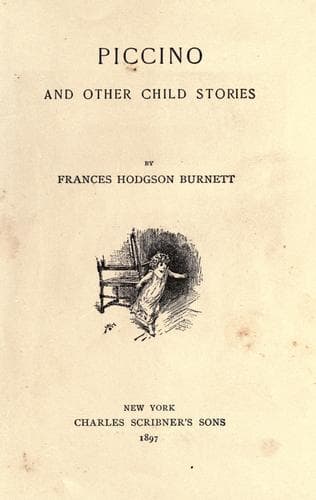
Piccino, and other child storiesBurnett, Frances Hodgson
General
Piccino, and other child stories
Burnett, Frances Hodgson
Children -- Conduct of life -- Juvenile fiction; Children's stories, American
And then it were—just at that instant—as his sharp young eyes spied
something out ahead of us, for he drew his hand away, and started
running, just throwing back a word or so to me.
“There’s a carriage before the door,” he said, “and they are getting
into it.”
He were up that street like a deer, and in half a minute I were
with him; but when I comes up, all out of breath, he were on the
carriage-step, holding the door open; and, what’s more, holding at bay
the black rascal who stood near, sneering and raging at him by turns.
“Rabbett,” he cries out, “help me to hold the door open. No—go to the
horses’ heads. Now, Rose, get out.”
I went to the horses’ heads, as I would have done if the captain
himself had give the order, instead of “The Captain’s Youngest.” It
made my heart ache, too, to hear the ring in the little chap’s voice,
so like his father’s, and then to remember what the captain might have
been—and what he were. Even the driver were struck all of a heap by the
youngster’s pluck, and were so busy looking at him that he let me take
my stand, without a word against it.
“Look here, mate,” he says to me, “here’s a rum go!”
“It’s bad enough,” says I. “Perhaps you’ll oblige me with them reins?”
“If you don’t come down from that step,” says Roscoe, saying every word
slow, as if he was trying to hold himself back from striking the boy a
blow as would kill him, “you impudent young devil, I will take the whip
from the box there and cut you to pieces!”
Then Miss Rose bends forward. It is my impression as the cruel,
murderous sound in the fellow’s voice was something she had never heard
before, and it frightened her.
“Don’t speak to him in that way, Basil,” she says. “Oh, Lionel, dear,
you shouldn’t have come. You must go back. You must, indeed. I shall
never come home again, Lionel.” And she burst out crying.
“I shall go back, Rose,” says the boy, “but you must come with me.
Rabbett and I came to fetch you, and we shall not leave you.” And then
he looks at Roscoe square. “I am not afraid of your cutting me to
pieces with your whip, sir,” he says. “Rabbett will see to that. But,”
and the fire blazed up in his voice and his face and his eyes, as grand
as if he had been the captain himself, “if I had come alone I would not
have left this carriage door unless Rose had come with me. You might
have used your whip, but you couldn’t have made me do that.”
“Am I,” says Roscoe, panting with the passion he dare not let out, “am
I to throw you into the street under the horses’ hoofs, you impudent
young devil?”
But Master Lionel’s back was turned to him. He was pleading with his
sister.
“Rose, dear,” he says, “come home with me. You will come home with me,
I know.” And he caught hold of her hand.
Public-domain text, read in full here on John Shaqi.
Reviews
Reviews
No reviews yet
Be the first to share your thoughts on this work.
Join the Discussion
Join the discussion
Sign in to leave a comment or review.
Sign InorCreate an account