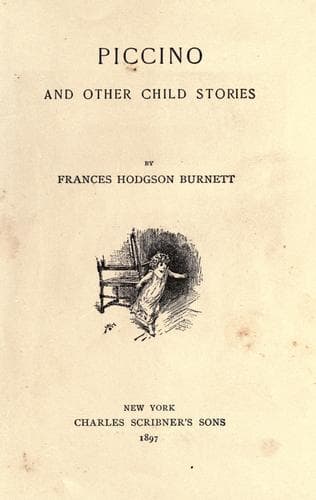
Piccino, and other child storiesBurnett, Frances Hodgson
General
Piccino, and other child stories
Burnett, Frances Hodgson
Children -- Conduct of life -- Juvenile fiction; Children's stories, American
God knows how it all happened—I don’t. If I had only been quick enough
to see in time, the captain’s youngest might have been alive this day,
a brave young fellow, such as the captain had been in those first days
in India—a brave, handsome young soldier, as would have been a honor to
his country, and a stanch friend yet to me.
But that weren’t to be. Just as he stood there, his foot on the
carriage-step, a-holding his sister’s hand, the passion in the heart
of the rascal watching him broke forth. He caught him by the shoulder,
there were a short struggle as the boy tried to free himself, and
before I could reach them he had whirled him away from the door—with
greater force than he intended, I’ve tried to believe. The frightened
horses lashed out their hoofs and sprang forward, struggling over the
child’s very body as he lay stunned under their feet.
Scoundrel as he was, I never could make it look square to myself as
the man meant the harm he did. His face was out and out deathly, as he
leaped forward to save him as quick as I did myself. But we were both
too late. We could only drag at the reins, and stop the horses in time
to prevent the wheels passing over him—that were all.
We had him out in a minute, and Miss Rose was out of the carriage,
kneeling on the pavement by him, and the driver was down off his box.
“Great God!” says Roscoe, “I never meant to do him such a harm. He’s
dead!” And he shuddered all over, with fear, perhaps, as much as
anything else.
But he weren’t dead, and he hadn’t even fainted, though he were stunned
at first. I had lifted him in my arms, and he lay against me, panting
a bit, and stone-white, all but for a stain of blood on one temple. It
weren’t his head as was so badly hurt, it were his side, where one of
the horses had lashed out and struck him. And as sure as I’m a living
man, in a few minutes he opens his eyes and lays hold of his sister’s
hand.
“Rose,” he says, “will you—go home—with me—now?”
She knelt over him, wringing her hands, and sobbing as if her heart
would break. She would not let her lover come near her. When he tried
to speak, she shrank away, shuddering.
It’s my belief as what she had seen in his face during the last ten
minutes would have broke her faith in him, even if the young master had
met no hurt. And now she were that terrified that she were as helpless
as a child.
“Is he much hurt?” she kept saying. “Rabbett, oh, Rabbett! let me take
him home to mamma. Put him into the carriage.” And then she turned upon
Roscoe, fierce and wild. “Go away,” she cried out. “You have killed
him! Go away, and never let me see you again!”
There were a dreadful house when we took him home. Mrs. Dalgetty
went out of one faint into another, as she always did when she were
frightened. The servants ran backward and forward, doing nothing, the
children crowded round us, crying, and the captain looked on at all we
did like a man in a dream.
Public-domain text, read in full here on John Shaqi.
Reviews
Reviews
No reviews yet
Be the first to share your thoughts on this work.
Join the Discussion
Join the discussion
Sign in to leave a comment or review.
Sign InorCreate an account