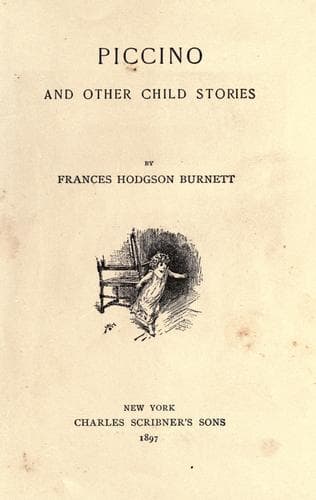
Piccino, and other child storiesBurnett, Frances Hodgson
General
Piccino, and other child stories
Burnett, Frances Hodgson
Children -- Conduct of life -- Juvenile fiction; Children's stories, American
In the first place, he had always been thought of as a little girl.
It was the old story of “Your sister, Betsey Trotwood;” and when he
presented himself, with an unflinching firmness, in the unexpected
character of a little boy, serious remonstrance was addressed to him.
“This habit you have contracted of being a little boy,” his mamma said
to him, “is most inconvenient. Your name was to be Vivien. ‘Vivien’
is Early English, and picturesque and full of color; Vivian, which is
a boy’s name, I don’t think so much of. It sounds like a dandy, and
reminds me of Vivian Grey; but, after the way you have behaved, it is
about all I can do for you, because I am too tired of thinking of names
to be equal to inventing anything else.”
If it had not been for his disguise, and his determination not to be
betrayed into the weakness of speech, it is quite possible he might
have responded:
“If you will trust the matter to me, I will manage to reconcile you to
the name, and make you feel there is some consolation for the fact that
I preferred to be myself, instead of Vivien. Just give me time.”
We were, of course, obliged to give him time, and he wasted none
of it. One of the favorite jokes was that he was endeavoring to
ingratiate himself with us, and by a strict attention to business to
merit future patronage. We felt it very clever of him to elect to do
this quietly; to occupy the position he had chosen for himself with
such unobtrusiveness that no one could possibly object to him. This
might really have been the deepest craft. To have proved one’s self
an individual to whom no one can object on any pretext, is really an
enormous step in the direction of gaining a foothold. It is quite
possible that he realized that the step he had taken had been somewhat
premature; that to introduce himself to a family absorbed in study and
foreign travel, and an elder brother aged eighteen months, had not
been entirely discreet, and that a general decorum of manner would
be required to obliterate the impression that he had been somewhat
inconsiderate.
His elder brother had decided to become a stately beauty, and after
some indeterminate months had set up as premonitory symptoms large
brown eyes, a deepening golden tinge of hair, and a distinguished and
gracefully exclusive demeanor. His opinion of the new-comer was that
he was an interloper. I think his private impression was that he was
vulgar, also that he was fatuous and unnecessary. He used to stand
by his nurse’s knee when she held the intruder, and regard her with
haughty reflection from under his eyelids. She had hitherto been his
sole property, and her defection seemed to him to denote inferior taste
and instability of character. On one occasion, after standing by her
in disapproving silence for some time, while he alternately looked at
her and then at the white bundle on her knee, he waved his hand toward
the grate, remarking, with more dignity of demeanor than clearness of
enunciation:
Public-domain text, read in full here on John Shaqi.
Reviews
Reviews
No reviews yet
Be the first to share your thoughts on this work.
Elsewhere in the archive
Join the Discussion
Join the discussion
Sign in to leave a comment or review.
Sign InorCreate an account