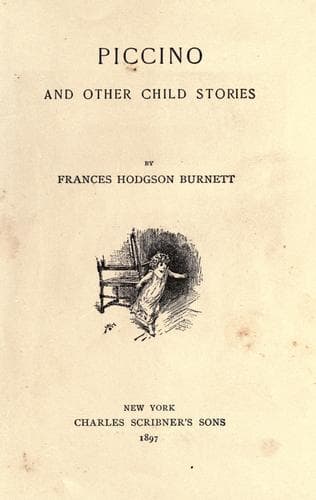
Piccino, and other child storiesBurnett, Frances Hodgson
General
Piccino, and other child stories
Burnett, Frances Hodgson
Children -- Conduct of life -- Juvenile fiction; Children's stories, American
He had not seemed to regret being born in Paris, but he seemed
agreeably impressed by America when he was taken there at the age of
six weeks. Feeling himself restored to a land of republican freedom, he
began to feel at liberty to unfold his hitherto concealed resources.
He began by giving less time to sleep and more to agreeable, though
inarticulate, conversation. He began to sit up and look around him
with soft, shadowy, and peculiarly thoughtful eyes. The expression—the
dear little dreamy, reflective expression—of his eyes was his most
valuable possession. It was a capital. It attracted the attention of
his immediate relatives and ensnared them into discussing his character
and wondering what he was thinking of. His eyes were brown, and having
heard their color remarked on in a complimentary manner, he, with great
artistic presence of mind, stealthily applied himself to developing
upon his hitherto bald head golden hair with a curl in it.
It was his mamma who first discovered this. She was lying upon a grassy
slope, playing with him, and holding him up in the sunlight at arm’s
length; she saw in the brightness a sort of faint little nimbus of gold
crowning him.
“Oh, the Lammie day!” she cried out. (“Lammie day” is not in the
dictionary; it was a mere maternal inspiration.) “See what he is doing
now! He is putting out a lovely little golden fuzz all over his head,
and there is a tiny curl at the ends—like little duck-tails! He has
asked somebody or something, perhaps a fairy, what kind of hair I
like with brown eyes, and he is doing it on purpose.” It seemed not
improbable that, on inquiring into her character before selecting her,
he had grounded himself thoroughly in the matter of her tastes, and had
found that an insistent desire for a certain beauty in the extremely
young was one of her weaknesses also.
From his earliest hours he considered her. He had not anticipated
walking alone at nine months old, but in their intimate moments he
discovered she had really set her heart upon his doing so.
“Your brother walked alone beautifully when he was nine months old,”
she would remark, “and if you wait until you are ten months old I shall
feel that you have dishonored your family and brought my reddish hair
with sorrow to the grave.”
This being the case, he applied himself to making determined, if slow,
little pilgrimages upon the carpet on his hands and knees. His reward
was that the first time he essayed this he was saluted with cries of
adulation and joy, notwithstanding the fact that his attempt was
rather wabbly in character, and its effect was marred by his losing his
balance and rolling over in a somewhat ignominious manner.
Public-domain text, read in full here on John Shaqi.
Reviews
Reviews
No reviews yet
Be the first to share your thoughts on this work.
Elsewhere in the archive
Join the Discussion
Join the discussion
Sign in to leave a comment or review.
Sign InorCreate an account