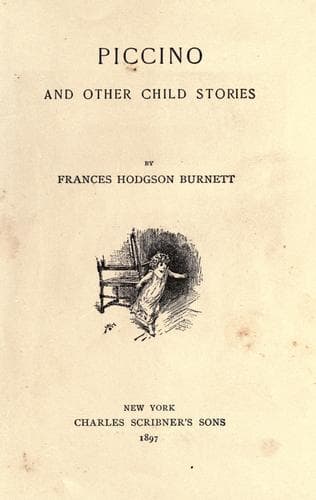
Piccino, and other child storiesBurnett, Frances Hodgson
General
Piccino, and other child stories
Burnett, Frances Hodgson
Children -- Conduct of life -- Juvenile fiction; Children's stories, American
“They wrote about the passing of bills in Parliament,” his parent
remarked, “and about wars and royal marriages; why don’t they touch on
things of really vital importance?” It was at this period of existence
that his papa was frequently distracted in moments of deep absorption
in scientific subjects, by being implored to leave his essay upon
astigmatism and revert his attention upon his offspring.
“Don’t waste him!” he was besought. “He could not possibly keep up this
degree of fascination always. He might grow out of it, and then just
think how you would feel when you reflected that you had read medical
books when you might have been watching him pretending to be looking at
pictures. He ought to be economized every moment!”
But the most charming feature of his character was that his knowledge
of the possession of glittering accomplishments, which were
innumerable, never betrayed him into forgetting that his attitude
toward the entire world was one of the most perfect good-fellowship.
When he was spoken to, he smiled; when he was kissed, even by
unprepossessingly familiar persons, he always comported himself with
graceful self-control and dignity. The trying fact, which I am sure was
more apparent to no one than to himself, that there were individuals
whose idea of entertaining him was to make blatant idiots of
themselves, was never resented by him openly. When they uttered strange
sounds, and poked his soft cheeks, or tumbled him about in an unseemly
manner, it was his habit to gaze at them with deep but not disdainful
curiosity and interest, as if he were trying to be just toward them and
explain to himself their point of view.
“It really must be rather fatiguing to him not to be able to express
himself,” was his mamma’s opinion. “He has evidently so many opinions
in reserve.”
He was so softly plump, he was so sweet-tempered, he was so pretty! One
forgot all about his Early English sister Vivien. It was as if she had
never been contemplated for a moment. The word “calamity” was artfully
avoided in conversation. One felt unworthy, and rather blushed if one
caught sight of it in literature. When he invented a special little
habit of cuddling up to his mamma in a warm, small heap, and in his
sleep making for her a heavenly downy necklace of both his arms, with
his diminutive palms locked together to hold her prisoner through the
night, she began to feel it quite possible that his enslaving effect
upon her might be such as to enfeeble an intellect even of the most
robust. But she knew him by this time well enough to realize that it
would be useless to rebel, and that she might as well succumb.
Public-domain text, read in full here on John Shaqi.
Reviews
Reviews
No reviews yet
Be the first to share your thoughts on this work.
Elsewhere in the archive
Join the Discussion
Join the discussion
Sign in to leave a comment or review.
Sign InorCreate an account