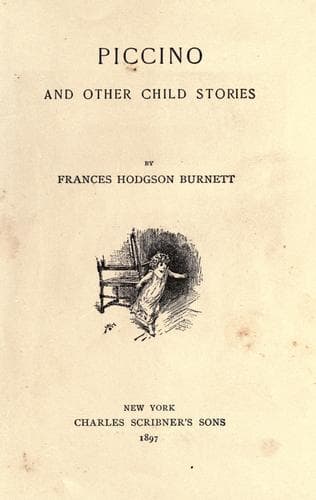
Piccino, and other child storiesBurnett, Frances Hodgson
General
Piccino, and other child stories
Burnett, Frances Hodgson
Children -- Conduct of life -- Juvenile fiction; Children's stories, American
So he conversed with Annunciata in the kitchen, and Luigi in the
dining-room, as it had been his habit to converse with Carrie and Dan
years before, for by this time his love-locks had been cropped and had
changed to brown, but he still remained the same charming and engaging
little person.
“Boys are sometimes a great trouble,” commented Luigi, in referring to
him and his brother, “but these—they are little _signorini_.”
Fauntleroy had “occurred” nearly four years before the time when he
exhausted all the resources of the Paris Exposition, but it was still
Fauntleroy, though a taller one, in schoolboy suit and Eton collar, and
shorn of his _boucles blondes_, who marched off at nine o’clock every
morning for two weeks, and spent the day exploring the treasures of the
exhibition. Sometimes he was quite alone, sometimes he had appointments
with some “friends” he had made in the passage from New York to
Havre—three interesting men whose connection with the electrical
exhibit inspired him with admiration and delight. My impression is that
they did not speak French, and that it enraptured him to place his
vocabulary at their disposal.
“They are so kind to me, dearest,” he said, just as he had said it at
three years old, when he visited his “friend Mrs. Wilkins.”
“It must be an entertaining spectacle,” I often thought, “to see him
walk into the restaurant quite unattended, order his little _déjeuner à
la fourchette_, dispose of it in dignified solitude at a small table,
and present the _garçon_ with a _pourboire_ as if he were forty. I
should like to be a spectator from afar. No doubt the waiters know him
and make jocular remarks among themselves.”
But it was when he was only seven that Fauntleroy really occurred. He
had been so amusing and interesting that summer, and I had reflected
upon him so much! Every few days I heard some delightful anecdote about
him, or saw him do something incomparably quaint. What led me most into
speculation was the effect he invariably produced upon people, touching
little fascinations he exercised.
“Do you know, I never saw a child like him!” said a clever man of the
world who had spent an hour talking to him.
And, curiously enough, it was exactly the idea expressed by an old
colored aunty years before. “Dat chile,” she said, “he suttanly
ain’t like no other chile. ’Tain’t jest dat he’s smart—though cose
he’s smart, smart as they make ’em. It’s sump’n else. An’ he’s the
frien’liest little human I ever seed—he suttanly is!”
I had been ill that year and the year before it, and of that illness
I have many memories which are beautiful and touching things. One is
of many disturbed and weary nights, when the door of my room opened
quietly and a little figure entered—such an adorable little figure,
in a white nightgown, and with bright hair, tumbled by sleep, falling
about a serious, small face.
Public-domain text, read in full here on John Shaqi.
Reviews
Reviews
No reviews yet
Be the first to share your thoughts on this work.
Elsewhere in the archive
Join the Discussion
Join the discussion
Sign in to leave a comment or review.
Sign InorCreate an account