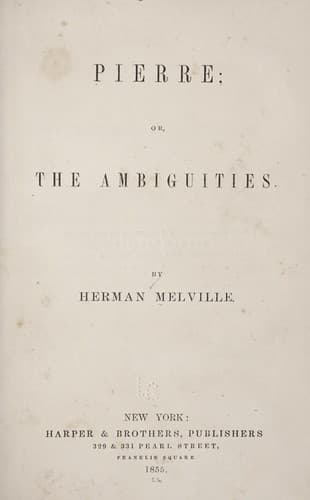
Autobiographical fiction; Domestic fiction; Male authors -- Fiction; Men -- Fiction; Psychological fiction
His mind was wandering and vague; his arm wandered and was vague. Some
moments passed, and he found the open Hamlet in his hand, and his eyes
met the following lines:
"The time is out of joint;--Oh cursed spite,
That ever I was born to set it right!"
He dropped the too true volume from his hand; his petrifying heart
dropped hollowly within him, as a pebble down Carrisbrook well.
III.
The man Dante Alighieri received unforgivable affronts and insults from
the world; and the poet Dante Alighieri bequeathed his immortal curse to
it, in the sublime malediction of the Inferno. The fiery tongue whose
political forkings lost him the solacements of this world, found its
malicious counterpart in that muse of fire, which would forever bar the
vast bulk of mankind from all solacement in the worlds to come.
Fortunately for the felicity of the Dilletante in Literature, the
horrible allegorical meanings of the Inferno, lie not on the surface;
but unfortunately for the earnest and youthful piercers into truth and
reality, those horrible meanings, when first discovered, infuse their
poison into a spot previously unprovided with that sovereign antidote of
a sense of uncapitulatable security, which is only the possession of the
furthest advanced and profoundest souls.
Judge ye, then, ye Judicious, the mood of Pierre, so far as the passage
in Dante touched him.
If among the deeper significances of its pervading indefiniteness, which
significances are wisely hidden from all but the rarest adepts, the
pregnant tragedy of Hamlet convey any one particular moral at all fitted
to the ordinary uses of man, it is this:--that all meditation is
worthless, unless it prompt to action; that it is not for man to stand
shilly-shallying amid the conflicting invasions of surrounding impulses;
that in the earliest instant of conviction, the roused man must strike,
and, if possible, with the precision and the force of the
lightning-bolt.
Pierre had always been an admiring reader of Hamlet; but neither his age
nor his mental experience thus far, had qualified him either to catch
initiating glimpses into the hopeless gloom of its interior meaning, or
to draw from the general story those superficial and purely incidental
lessons, wherein the painstaking moralist so complacently expatiates.
The intensest light of reason and revelation combined, can not shed such
blazonings upon the deeper truths in man, as will sometimes proceed from
his own profoundest gloom. Utter darkness is then his light, and
cat-like he distinctly sees all objects through a medium which is mere
blindness to common vision. Wherefore have Gloom and Grief been
celebrated of old as the selectest chamberlains to knowledge? Wherefore
is it, that not to know Gloom and Grief is not to know aught that an
heroic man should learn?
Public-domain text, read in full here on John Shaqi.
Reviews
Reviews
No reviews yet
Be the first to share your thoughts on this work.
Elsewhere in the archive
Join the Discussion
Join the discussion
Sign in to leave a comment or review.
Sign InorCreate an account