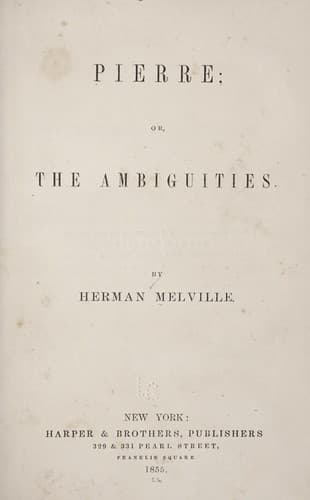
Autobiographical fiction; Domestic fiction; Male authors -- Fiction; Men -- Fiction; Psychological fiction
As Pierre, now hurrying from his chamber, was rapidly passing through
one of the higher brick colonnades connecting the ancient building with
the modern, there advanced toward him from the direction of the latter,
a very plain, composed, manly figure, with a countenance rather pale if
any thing, but quite clear and without wrinkle. Though the brow and the
beard, and the steadiness of the head and settledness of the step
indicated mature age, yet the blue, bright, but still quiescent eye
offered a very striking contrast. In that eye, the gay immortal youth
Apollo, seemed enshrined; while on that ivory-throned brow, old Saturn
cross-legged sat. The whole countenance of this man, the whole air and
look of this man, expressed a cheerful content. Cheerful is the
adjective, for it was the contrary of gloom; content--perhaps
acquiescence--is the substantive, for it was not Happiness or Delight.
But while the personal look and air of this man were thus winning, there
was still something latently visible in him which repelled. That
something may best be characterized as non-Benevolence. Non-Benevolence
seems the best word, for it was neither Malice nor Ill-will; but
something passive. To crown all, a certain floating atmosphere seemed to
invest and go along with this man. That atmosphere seems only renderable
in words by the term Inscrutableness. Though the clothes worn by this
man were strictly in accordance with the general style of any
unobtrusive gentleman's dress, yet his clothes seemed to disguise this
man. One would almost have said, his very face, the apparently natural
glance of his very eye disguised this man.
Now, as this person deliberately passed by Pierre, he lifted his hat,
gracefully bowed, smiled gently, and passed on. But Pierre was all
confusion; he flushed, looked askance, stammered with his hand at his
hat to return the courtesy of the other; he seemed thoroughly upset by
the mere sight of this hat-lifting, gracefully bowing, gently-smiling,
and most miraculously self-possessed, non-benevolent man.
Now who was this man? This man was Plotinus Plinlimmon. Pierre had read
a treatise of his in a stage-coach coming to the city, and had heard him
often spoken of by Millthorpe and others as the Grand Master of a
certain mystic Society among the Apostles. Whence he came, no one could
tell. His surname was Welsh, but he was a Tennesseean by birth. He
seemed to have no family or blood ties of any sort. He never was known
to work with his hands; never to write with his hands (he would not even
write a letter); he never was known to open a book. There were no books
in his chamber. Nevertheless, some day or other he must have read books,
but that time seemed gone now; as for the sleazy works that went under
his name, they were nothing more than his verbal things, taken down at
random, and bunglingly methodized by his young disciples.
Public-domain text, read in full here on John Shaqi.
Reviews
Reviews
No reviews yet
Be the first to share your thoughts on this work.
Elsewhere in the archive
Join the Discussion
Join the discussion
Sign in to leave a comment or review.
Sign InorCreate an account