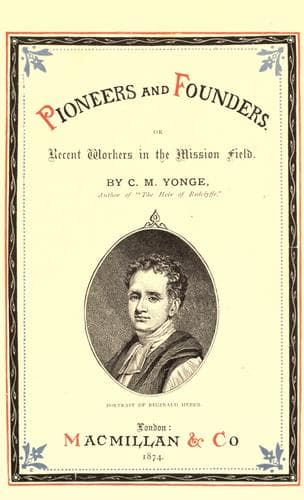
Pioneers and Founders: or, Recent Workers in the Mission fieldYonge, Charlotte M. (Charlotte Mary)
History
Pioneers and Founders: or, Recent Workers in the Mission field
Yonge, Charlotte M. (Charlotte Mary)
Missionaries
ashore at once; and poor Carey beheld with tears the Indian fleet sailing
from Portsmouth without him.
However, by vigorous exertion, Thomas found that a Danish ship would be
lying in the Downs, on her way to the East Indies, and that a passage in
her would cost 100_l._ for a full-grown person and 50_l._ for a child.
Posting down to Northamptonshire, Carey made a desperate effort to
persuade his wife to come with him, and succeeded at last, on condition
that her sister, Miss Old, should come too. There were now five
children, and the passage-money for the whole party amounted to 600_l._,
of which their utmost efforts, including the sale of all the little
property the Careys possessed, could only raise half.
Thomas, who really had a generous spirit, then arranged that the whole
party should be squeezed into two cabins, and that Mr. and Mrs. Carey
alone should be treated as first-class passengers. They were taken on
these terms; but the captain, an Englishman, naturalized in Denmark, gave
Mr. Thomas and Miss Old each a cabin, made them dine at his own table,
and treated them all most kindly.
Thus they safely arrived at Calcutta; but this was only the beginning of
troubles. The goods, the sale of which was intended to maintain the
mission, were entrusted to Thomas, and realized next to nothing; and
Carey was indebted to the goodwill of a rich Hindoo for a miserable house
in an unhealthy suburb of Calcutta, where he lodged his unfortunate
family. They had a great deal of illness, and he was able to do little
but study the language and endeavour to translate the Bible into
Bengalee. Several moves made their state rather worse than better,
until, in 1795, a gentleman in the Civil Service, Mr. George Udney,
offered Carey the superintendence of an indigo factory of his own at
Mudnabutty, where he hoped both to obtain a maintenance, and to have
great opportunities of teaching the natives in his employment.
Disaster as usual followed him: the spot was unhealthy, the family had
fevers, one of the children died, and the mother lost her reason from
grief, so that she had to be kept under restraint for the rest of her
life. Nor was Carey a better indigo-planter than a shoe-maker; the
profits of the factory dwindled, and the buildings fell into ruin; the
seasons were bad, and in three years Mr. Udney found himself obliged to
give up the speculation; but in the meantime, though Carey had not been
able to produce much effect on the natives, he had completed the
preparation of the implement to which he most trusted for his work, a
translation of the New Testament; and, moreover, had been presented by
good Mr. Udney with a wooden printing-press with Bengalee type. The
wonderful-looking thing was set up in one of the side rooms at the
factory, and was supposed by the natives to be the idol of the Europeans!
Public-domain text, read in full here on John Shaqi.
Reviews
Reviews
No reviews yet
Be the first to share your thoughts on this work.
Elsewhere in the archive
Join the Discussion
Join the discussion
Sign in to leave a comment or review.
Sign InorCreate an account