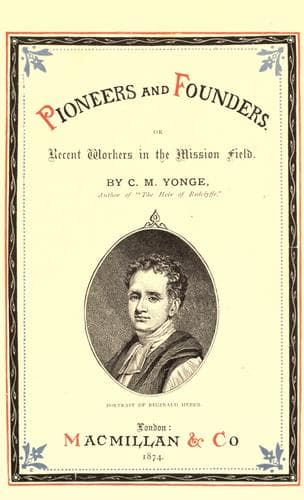
Pioneers and Founders: or, Recent Workers in the Mission fieldYonge, Charlotte M. (Charlotte Mary)
History
Pioneers and Founders: or, Recent Workers in the Mission field
Yonge, Charlotte M. (Charlotte Mary)
Missionaries
Mr. Thomas had meantime engaged himself as superintendent of a sugar
factory at Beerbhoom, whence he came to visit his brethren at Serampore,
bringing with him one of his workmen named Fukier, whom he believed that
he had converted. The man gave so good an account of his faith that the
missionaries deemed him fit for baptism, and rejoiced in him as the first-
fruits of seven years' labour; but he went home to take leave of his
friends, and either they prevailed on him to give up his intention, or
privately murdered him, for he never was heard of again.
However, a carpenter of Serampore named Krishnu, who had been brought
into the mission-house with a dislocated arm for Mr. Thomas to set, was
so struck by what he heard there that he, with his wife and daughter and
his brother Goluk, were all willing to give up their caste and be
baptized.
There was much, however, to render the joy of this day far from being
unmixed. Poor John Thomas, after his seventeen years of effort, fitful,
indeed, but sincere, was so overjoyed at this confession of faith that he
became frantic, and in three days was raving violently. Meanwhile, the
native mob, infuriated by hearing that Krishnu and Goluk had renounced
their caste, rose to the number of two thousand, and dragged them to the
magistrate, but found nothing to accuse them of. The magistrate released
them, but they were brought back immediately after, on the plea that the
person to whom Krishnu's daughter had been betrothed had a claim upon
her. This, however, the authorities disallowed, and they even gave the
missionaries a guard to secure them from any interruption during the rite
of Baptism, which, by the customs of their sect, was necessarily in
public, and by immersion; but there was serious consultation whether it
were fit to use the Ganges, so superstitiously adored by the natives, for
the purpose. Some argued that the Hindoos might think that the
sacredness of Gunga was thus recognized, others that they would consider
that the Christians had defiled it, and it was finally resolved to use it
like any other stream. In the meantime, Goluk and the two women had been
so much terrified that they would not come forward; and on the day of the
baptism, Sunday, the 26th of December, 1800, the only two candidates were
Krishnu and Felix Carey, the missionary's own eldest son. William Carey
walked from the chapel to the ghat, or steps leading to the river, with
his son on one side and the Hindoo on the other; but the court they had
to pass resounded with the frightful imprecations of poor Mr. Thomas in
one room, echoed by screams from Mrs. Carey in the other.
At the ghat the Danish governor himself, together with several of his
countrymen, some Englishmen, a large body of Portuguese, and a throng of
natives, Hindoo and Mahometan, were waiting, and before all these the
baptism was performed by Mr. Carey. All were silent as if overawed, and
Colonel Bie even shed tears.
Public-domain text, read in full here on John Shaqi.
Reviews
Reviews
No reviews yet
Be the first to share your thoughts on this work.
Elsewhere in the archive
Join the Discussion
Join the discussion
Sign in to leave a comment or review.
Sign InorCreate an account