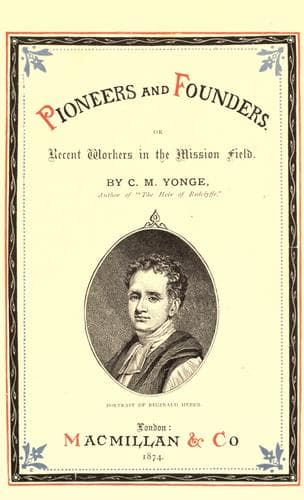
Pioneers and Founders: or, Recent Workers in the Mission fieldYonge, Charlotte M. (Charlotte Mary)
History
Pioneers and Founders: or, Recent Workers in the Mission field
Yonge, Charlotte M. (Charlotte Mary)
Missionaries
"There had been but few men at Serampore, but they were all giants," was
said of them by one of the dignitaries of the Church and assuredly it was
a wonderful triumph, that a shoe-maker, a schoolmaster, and a printer
should in thirty-eight years not only have aroused the missionary spirit
in England, but have, by their resolution and talent, established thirty-
three stations for the preaching of Christianity in India; while at the
time of the death of the last survivor, forty-nine ministers were in
union with them, half of whom were natives of Hindostan, and around each
of the elder stations was a fair proportion of converts. Still more
amazingly, these self-educated men had, by their accurate knowledge and
deep study, become most eminent authorities in matters of language and
philology; and by their usefulness had actually compelled a prejudiced
Government to depend on them for assistance, and thus to support the work
for which alone they cared. Never were the words more completely
fulfilled than in them, "Seek ye first the kingdom of God and His
righteousness, and all these things shall be added unto you."
The reverses that chequered their wonderful success were not the more
interesting difficulties of wild country, or persecuting heathen, but
troubles with an obstructive Government, and with the Society at home,
which endeavoured to rule them without understanding them. These
vexations are inseparable from the conditions of Societies trying to
govern from home instead of letting the management be carried on by a
head upon the spot.
CHAPTER VI. THE JUDSON FAMILY.
We must turn to an important offshoot from the Serampore mission, which
assumed extensive proportions and a character of its own, chiefly in
consequence of American zeal. Here, be it observed, was the first ground
attempted by modern missions (not Roman Catholic) which belonged to an
independent sovereign.
The great Burmese Empire, roughly speaking, occupies the Eastern India
peninsula, being separated from that of Hindostan by the Brahmapootra
river. The mountainous formation of the country, its indented coast, and
numerous rivers render it fertile, and the hills contain many valuable
metals and beautiful precious stones.
The inhabitants are of the Mongolian race, short, stout, active, and
brown, with a good deal of ingenuity in arts and manufactures, but not
equal to the Chinese, their neighbours. Their language is monosyllabic,
their religion Buddhist, their government a despotic empire, and at the
time the mission was entered upon they had had little intercourse with
strangers, but their women were not secluded, were not wholly uneducated,
and were treated with consideration.
Public-domain text, read in full here on John Shaqi.
Reviews
Reviews
No reviews yet
Be the first to share your thoughts on this work.
Elsewhere in the archive
Join the Discussion
Join the discussion
Sign in to leave a comment or review.
Sign InorCreate an account