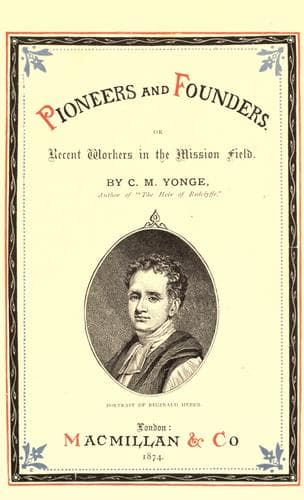
Pioneers and Founders: or, Recent Workers in the Mission fieldYonge, Charlotte M. (Charlotte Mary)
History
Pioneers and Founders: or, Recent Workers in the Mission field
Yonge, Charlotte M. (Charlotte Mary)
Missionaries
Her hope was in a petition to the Queen, but being under arrest herself,
she could not go to the Queen in person, and had to approach her through
her sister-in-law--a proud, haughty dame, who received her in the most
cold, discouraging manner, but who undertook to present the petition. She
then went to the prison again, but the head writer would not allow her to
enter; and on her return home she found that all the property in the
mission-house was to undergo a scrutiny; but this was humanely done, and
was only inventoried, not seized--_i.e._ the King did not seize it, but
the officials helped themselves to whatever took their fancy. The next
day the Queen's answer was obtained--"He is not to be executed; let him
remain where he is."
The poor lady's heart fainted within her, but she thought of the widow
and the unjust judge, and persevered day after day in applying to every
member of the royal family or of Government to entreat for her husband's
liberation. The King's mother, sisters, and brother were all interested
in his favour, but none of them ventured to apply direct to the King lest
they should offend the favourite Queen. All failed, but the hopes that
from time to time were excited, kept up the spirits of the sufferers.
During the long weary months while the missionaries continued in fetters,
_i.e._ chained by the feet to a bar of bamboo, Mrs. Judson was often not
allowed to visit them for ten days at a time, and then only by walking to
the prison after dark, two miles, unattended. She could, however,
communicate with her husband by means of the provisions she sent him
daily. At first she used to write on the dough of a flat cake, which she
afterwards baked and concealed in a bowl of rice, while he answered by
writing on a tile, where the inscription disappeared when dry but was
visible when wet; but latterly they found it most convenient to write on
a roll of paper hidden in the long nose of a coffee-pot, in which tea was
sent to the prisoners.
Mrs. Judson delighted to send him little surprises, once a mince-pie,
which Moung Ing carried with the utmost pride to his imprisoned master.
Mrs. Judson found herself obliged to wear the native dress, though she
was so much taller than the Burmese women that she could be hardly taken
for one of them. It was a becoming dress; her hair was drawn into a knot
on the forehead, with a cocoa-blossom, like a white plume, drooping from
it; a saffron vest open in front to show a crimson tunic below; and a
tight skirt of rich silk, sloping down behind, made her look to
advantage, so that her husband liked to remember her as she stood at his
prison door. She never was allowed to come further.
For twenty days she was absent, and then she came with a tiny, pale,
wailing, blue-eyed baby on her breast. Poor Judson, clanking up to the
door in his chains to welcome his little daughter, commemorated his
feelings in some touching verses ending:--
Public-domain text, read in full here on John Shaqi.
Reviews
Reviews
No reviews yet
Be the first to share your thoughts on this work.
Elsewhere in the archive
Join the Discussion
Join the discussion
Sign in to leave a comment or review.
Sign InorCreate an account