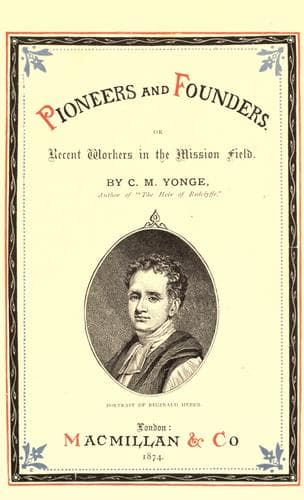
Pioneers and Founders: or, Recent Workers in the Mission fieldYonge, Charlotte M. (Charlotte Mary)
History
Pioneers and Founders: or, Recent Workers in the Mission field
Yonge, Charlotte M. (Charlotte Mary)
Missionaries
The three elder children were to go with her,
but the three little ones were to remain, since their father only
intended to go as far as the Isle of France, and then return to his
labour. The last words she ever wrote were pencilled on a slip of paper,
intended to be given to him to comfort him at their farewell:--
"We part on this green islet, love:
Thou for the Eastern main,
I for the setting sun, love;
Oh! when to meet again?
My heart is sad for thee, love,
For lone thy way will be;
And oft thy tears will fall, love,
For thy children and for me.
The music of thy daughter's voice
Thou'lt miss for many a year,
And the merry shout of thine elder boys
Thou'lt list in vain to hear.
* * * * *
Yet my spirit clings to thine, love,
Thy soul remains with me,
And oft we'll hold communion sweet
O'er the dark and distant sea.
And who can paint our mutual joy
When, all our wanderings o'er,
We both shall clasp our infants three
At home on Burmah's shore?
But higher shall our raptures glow
On yon celestial plain,
When the loved and parted here below
Meet, ne'er to part again.
Then gird thine armour on, love,
Nor faint thou by the way
Till Boodh shall fall, and Burmah's sons
Shall own Messiah's sway."
What a trumpet-note for a soldier to leave after nineteen years service
"through peril, toil, and pain," undaunted to the last! For by the time
the ship left the Isle of France, she was fading so rapidly that her
husband could not quit her, and sailed on with her to St. Helena. She
was fast dying, but so composed about her children, that some one
observed that she seemed to have forgotten the three babes. "Can a
mother forget?" was all her answer. She died on board the ship, at
anchor in the bay of St. Helena, and was carried to the burial-ground,
where all the colonial clergy in the island attended, and she was laid
beside Mrs. Chater, the wife of that Serampore missionary whose expulsion
had led to the first pioneering at Rangoon, and who had since worked in
Ceylon. She was just forty-two, and died September 1st, 1845.
Her husband found her beautiful farewell; and, as he copied it out, he
wrote after the last verse, "Gird thine armour on," "And so, God willing,
I will yet endeavour to do; and while her prostrate form finds repose on
the rock of the ocean, and her sanctified spirit enjoys sweeter repose on
the bosom of JESUS, let me continue to toil on all my appointed time,
until my change too shall come."
Public-domain text, read in full here on John Shaqi.
Reviews
Reviews
No reviews yet
Be the first to share your thoughts on this work.
Elsewhere in the archive
Join the Discussion
Join the discussion
Sign in to leave a comment or review.
Sign InorCreate an account