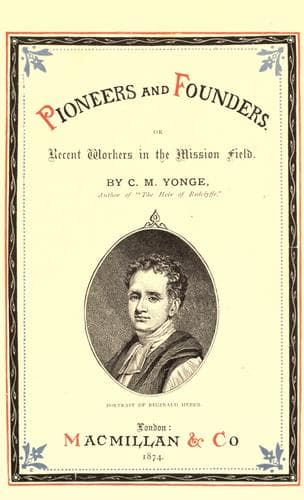
Pioneers and Founders: or, Recent Workers in the Mission fieldYonge, Charlotte M. (Charlotte Mary)
History
Pioneers and Founders: or, Recent Workers in the Mission field
Yonge, Charlotte M. (Charlotte Mary)
Missionaries
The difficulties as to the form of ordination of such as were not British
subjects had also been overcome, and Christian David was to be sent up
from Ceylon in company with Mr. Armour, who was to receive Priest's
orders. The latter excellent man died just before he was to set off, and
this delayed David until the next spring, when he came to Calcutta, was
lodged in Bishop's College, passed an excellent examination, and was
ordained deacon on Holy Thursday, 1824, and priest on the ensuing Trinity
Sunday. He is memorable as the first man of the dark-skinned races
admitted by the Church of England to her ministry. An excellent and well-
expressed letter from him, on the difficulties respecting the
distinctions of caste, is given in Bishop Heber's Life. This, indeed,
was one of the greatest troubles in dealing with converts. The Serampore
missionaries had striven to destroy it, but Ziegenbalg, Schwartz, and
their elder companions, regarded it as a distinction of society--not
religious--and, though discouraging it, had not so opposed it as to
insist on high and low castes mingling indiscriminately in church or at
meals. The younger men who had since come out had been scandalized, and
tried to make a change, which had led to much heartburning.
Next to his hymns, Bishop Heber is best known by the journal he kept of
his visitation tour, not intended for publication but containing so much
of vivid description of scenery and manners, that it forms a valuable
picture of the condition of Hindostan as it then was.
His first stage, in barges along the Ganges, brought him to Dacca, where
he was delayed by the illness and death of his much esteemed and beloved
chaplain. He then went on to Bhaugulpore, where he was much interested
in a wild tribe called the Puharries, who inhabit the Rajmahal hills,
remnants of the aborigines of India. They carried bows and arrows, lived
by the chase, and were viewed as great marauders; but they had a
primitive faith, free from idolatry, hated falsehood, and, having no
observance of caste and a great respect for Europeans, seemed promising
objects for a mission; but unfortunately the climate of their mountains
was so injurious to European life, that the clergyman, Mr. Thomas
Christian, a scholar of Bishop's College, whom the Bishop appointed to
this mission, was only able to spend three months in the hills in the
course of the year, while for the other nine he took the children under
his instruction back with him to Bhaugulpore.
At Bankipore, the Bishop met Padre Giulio Cesare, still a remarkably
handsome and intelligent-looking little man, and speaking warmly of Henry
Martyn. Dinapore, that first station of Martyn's, had since his time
fallen into a very unsatisfactory state, owing to the carelessness of his
successor, though it was newly come into better hands.
Public-domain text, read in full here on John Shaqi.
Reviews
Reviews
No reviews yet
Be the first to share your thoughts on this work.
Elsewhere in the archive
Join the Discussion
Join the discussion
Sign in to leave a comment or review.
Sign InorCreate an account