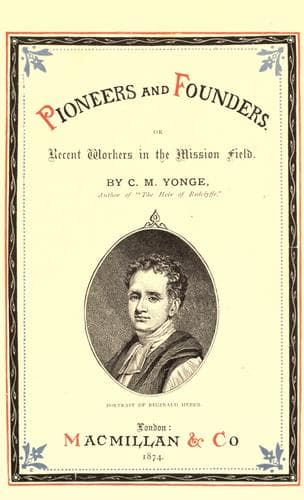
Pioneers and Founders: or, Recent Workers in the Mission fieldYonge, Charlotte M. (Charlotte Mary)
History
Pioneers and Founders: or, Recent Workers in the Mission field
Yonge, Charlotte M. (Charlotte Mary)
Missionaries
In his last letter to the Society for the Propagation of the Gospel, the
Bishop records the reception into Bishop's College of Mesrop David, the
kinsman of the Armenian Bishop and already a deacon; also of two native
youths from Ceylon, one Tamul and one Cingalese. This college, though a
work which had none of the romance of adventure about it, afforded the
surest and most important means of thoroughly implanting the Gospel, and
forming a native priesthood fit for the varying needs of the various
people. Nor could such a task be committed to any but superior men. Only
such as have abilities that would win them distinction in England, are
fit to cope with the difficulties of dealing with intellects quite as
argumentative as, and even more subtle than, those of the ordinary level
of Englishmen.
Soon after writing this letter, Bishop Heber set forth on what was to
prove his last visitation. On the voyage to Madras, he spent much time
upon some invalid soldiers who were being sent home, and confirmed one of
them on board. Also he devoted himself to comforting a poor lady whose
baby died on the voyage, not only when with her in her cabin, but
Archdeacon Robinson, his chaplain, could hear him weeping and praying for
her when alone in his own.
At Madras, he was lodged in the house of Sir Thomas Munro, the governor,
who had done much by the help of his excellent wife to promote all that
was good. At Vepery, close at hand, the Bishop found, nearly finished,
the first church built in the Gothic style in India. He was greatly
delighted with it, and especially that the desk and pulpit had not been
allowed to obstruct the view of the altar, which had more dignity than
was usual in the churches of 1826. A monstrous pulpit in another little
church at Poonamalee, a depot for recruits, and an asylum for pensioners
and soldiers' children, he caused to be removed. He had a confirmation
at this place, or rather two, for some unexpected candidates presented
themselves, and he desired Archdeacon Robinson to examine them, so that
they might be confirmed later in the day. Among them was an old
pensioner, and a sickly-looking young woman with a little boy, whom the
Archdeacon thought too young, and recommended her to keep back for
another opportunity. She wept much, and the Bishop said, "Bring them
both to me; who knows whether they may live to wish for it again?" The
native Christians, poor people employed on the beach, remnants of the old
Portuguese Missions, had built a church at their own expense, and, being
unable to obtain regular ministrations from their own clergy, begged the
Bishop to consecrate their building, and give them a clergyman, and this
he hoped to do on his return.
Public-domain text, read in full here on John Shaqi.
Reviews
Reviews
No reviews yet
Be the first to share your thoughts on this work.
Elsewhere in the archive
Join the Discussion
Join the discussion
Sign in to leave a comment or review.
Sign InorCreate an account