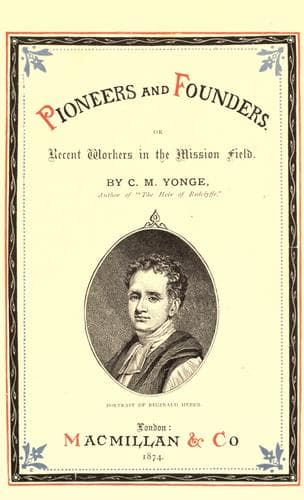
Pioneers and Founders: or, Recent Workers in the Mission fieldYonge, Charlotte M. (Charlotte Mary)
History
Pioneers and Founders: or, Recent Workers in the Mission field
Yonge, Charlotte M. (Charlotte Mary)
Missionaries
Mrs. Heber published soon after her return her husband's journals, and
these, bearing the impress of his graceful, scholarly hand, attracted
many readers who care merely for information and amusement; and thus, by
their mere mundane qualities, his writings did much to spread knowledge
of, and therefore interest in, the field of labour in which he died.
Large subscriptions came into the societies, and in a few years a church
and three schools for the natives, with the pastor he had indicated,
served as the best monument of that Low Sunday at Trichinopoly.
His successor was John Thomas James: the most memorable event in whose
life was a halt at the Cape of Good Hope. This was the first time that
colony had ever been visited by a Bishop, and there was no church, though
a piece of land had been newly granted for one, which he consecrated
before proceeding on his voyage. He arrived in 1828, but the climate of
Calcutta struck him for death almost immediately. He was only able to
perform one ordination, one confirmation, and one charge to the Calcutta
clergy, then was forced to embark, and died at sea within a few months of
his arrival.
During this time Daniel Wilson had been working under Mr. Cecil at
Chobham, where he remained for three years, when a tutorship at St.
Edmund's Hall was offered to him, which enabled him to marry his cousin
Ann, combining the small living of Warton with his tutorship. On the
death of the Rev. Richard Cecil he took, by his especial wish, his
proprietary chapel in Bloomsbury, and there continued till 1824 as one of
the most marked London clergy, keeping up the earnestness that Newton and
Cecil had been noted for, with quite as much energy; and though without
the same originality, there was a _telling_ force about his sermons which
made a young man exclaim the first time he heard him, "I will never hear
Daniel Wilson again," but something led him happily to infringe the
resolution, and then it became, "I will always, if possible, hear Daniel
Wilson." Sentences of his were very memorable; for instance, "Nineteen-
twentieths of sanctification consist in holy tempers," and, besides
exhibiting a pithy force of language, his sermons were prepared with
infinite care and labour. When at St. John's, where he had no parochial
charge, he selected his text on Monday and carried it about with him, so
to speak, all the week, chewing the cud of it as it were, looking it up
in every authority, ancient or modern, within his reach, and conversing
on the subject with any one whom he thought likely to give him a hint.
The sermons were written in a large legible shorthand, only on one side
of the paper, and on the opposite page were copied out extracts of
translations from illustrative authors, often as many as eight to a
single sermon, so that he had in fact a huge secretion of stores, which
he could adapt according to the needs of his congregation, and he made
notes of what he found fall flat and incomprehensible, or what he felt
Public-domain text, read in full here on John Shaqi.
Reviews
Reviews
No reviews yet
Be the first to share your thoughts on this work.
Elsewhere in the archive
Join the Discussion
Join the discussion
Sign in to leave a comment or review.
Sign InorCreate an account